Tuesday, June 26, 2012

Buoyancy and Stability (basic, part 1)

 .


Why do boats & ships float? Why do they stay right-side up, or why do they capsize? There are some fairly simple laws of physics which govern how vessels behave, and to be good sailors we should understand all this.

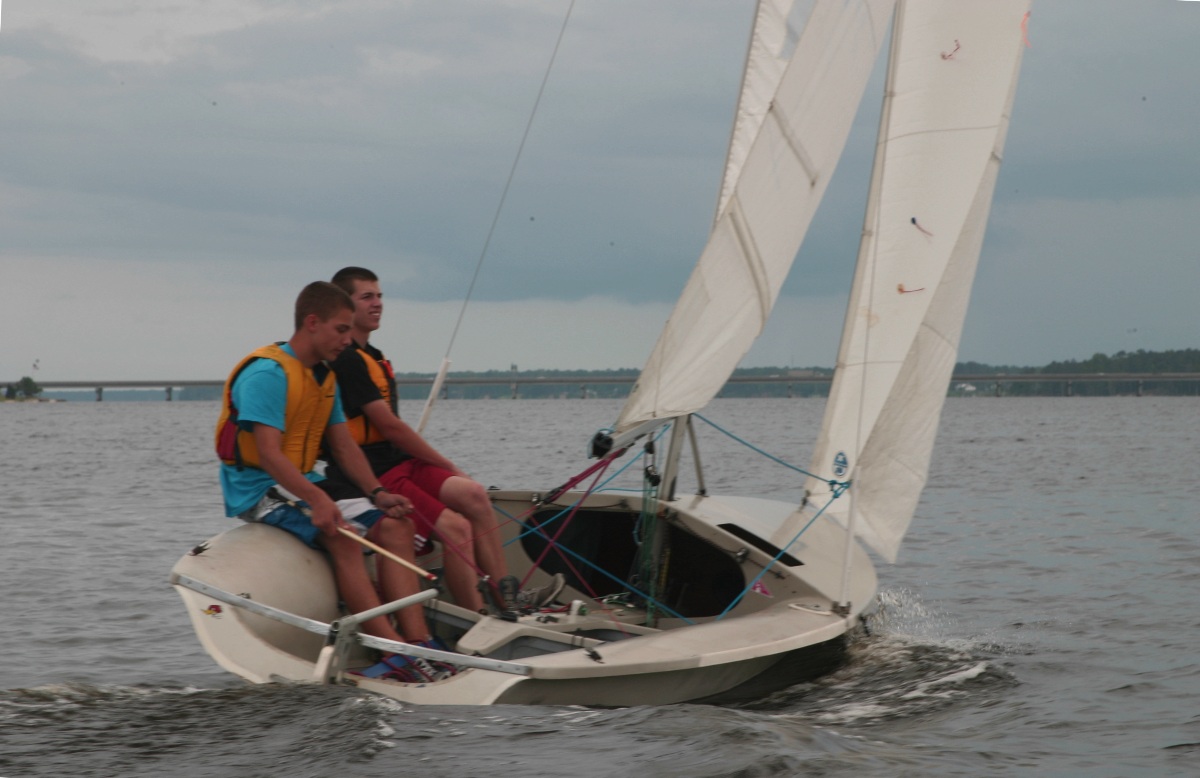
Here is a sailboat which has lost both buoyancy and stability. Good thing the sailors are wearing life jackets!


Buoyancy first... why do vessels float (or not)? Anybody who has picked up a container of it knows that water is heavy. If you take a given container, gallon or liter or whatever, and fill with water, of course it becomes much heavier.

To say more precisely, water has a lot of MASS for a given amount (size of container)... or you could say that it has greater DENSITY (link to wikipedia) than many other things we're familiar with... this is the most accurate statement, and it explains things better. After all, our container was full of AIR before we filled it with water, and water has a greater density than air. A bigger bucket full of water would be heavier, but that would not mean that the water in the bgger bucket has a greater density than the water in a smaller bucket.


RELATIVE DENSITY- the core of a star is more dense than a brick, which is more dense than water, which is more dense than air, which is more dense than helium...

So far this is common sense. A lot of science -IS- common sense, only put into terms that we can use with math to figure out how much or how little or how fast etc etc. And science has to go beyond what we "know" as common sense from our every day experiences. For example, you might think it's silly to point out that a bucket full of air weighs less than a bucket full of water; our common sense tells us that the density of air is nothing (and that's true, relative to the air all around) but you could not design an airplane using this "common sense."

"Relative Density" is the key to understanding buoyancy. Helium is less dense than air, so a helium balloon is buoyant... in air! If we released a helium balloon on a planet with hydrogen gas as it's atmosphere, that balloon would fall to the ground because helium is more dense than hydrogen!


Is a boat like a balloon? In some ways, yes. It floats in air instead of water... wait a minute, a balloon floats on water too, if it's placed there... unlike a boat, a balloon will rise upward out of sight! Does it go up forever? No, it stops going up once it gets to an altitude where the air density matches that of the material inside the balloon... but doesn't a boat float on top of the water because it is less dense than than the water, but more dense than the air? So a boat rises too, as long as the relative densities of the materials contribute to the force of "buoyancy." Therefor, a balloon is more like a boat than we thought!


BUOYANCY is the force produced by difference in density between an object and the medium surrounding it... an iron weight actually weighs less when immersed in water, although it's MASS remains the same...

In this diagram, we see a 7 pound iron weight lowered into a bucket of water. We've cleverly put a spout into the side of the bucket, and filled it right up to that spout.

As we lower the iron weight into the water, it pushes a volume of water aside. The water level in the bucket starts to rise but instantly runs out the spout. The volume of water pushed aside and out, in other words DISPLACED, is the same as the volume of the iron weight. But because of the difference in density between water & iron, that volume of water weighs only 3 pounds. The force of buoyancy reduces the apparent weight of the iron, but not by enough to make it stay afloat.


In the next diagram, the iron weight is hollowed out. Air is less dense than iron (duh) so now it weighs less, and it floats!

Does it float because there's air inside?

Yes and no... if the weight of the water displaced were less than the weight of the hollowed-out iron,  then it would still sink. But we have not reduced the volume of the iron weight, just it's mass. If we removed 4 1/2 pounds of iron from the middle, then it will now float because the buoyancy can produce enough force to support it against gravity.


Now let's take a big look at buoyancy and how we apply the physics to real vessels. We have a lighthouse, two ships, two submarines, a dirigible, and a brick.

Of course, the lighthouse is on land, so no worries there. We have two warships, one of which is fully loaded with fuel & ammunition, so (as we'd expect) it is lower in the water... it DISPLACES more because of the additional weight. At the advanced level, we will learn how to calculate safe loading & changes in draft & effect on stability.

We also see two submarines. One is very near the surface, maybe the captain is looking thru the periscope. The other is much deeper. Both are held up by the force of buoyancy, carefully balanced against the weight of water in their ballast tanks.

Yes, the US Navy had airships (link)... may have more in the near fuure. What happens to an airship (with regard to bouyancy & altitude) as it burns fuel?

The brick is sinking to the bottom. Because that's what bricks do.


Now for STABILITY... this is the tendency of a vessel to return to upright. There are several ways to measure stability, such as how far over a vessel can heel (lean or tip) before losing stability & capsizing, or the leverage exerted at a certain degree of heel (link to wikipedia).


.


You can see why we need to understand buoyancy to understand stability. You can also see that stability must not be taken for granted. Beginner sailors are often nervous when their boat leans over. Their "common sense" is telling them that they are about to have a disaster... but floating vessels follow different rules and given a reasonable level of skill & attention, they're fine. 

However there have certainly been ship capsizes (link to news) and they are always a major disaster!! The fact that Navy ships rarely suffer this problem is a testament to the training & skill of Navy sailors.


.


Another of those "common sense into science" pieces... we easily grasp that putting a heavy weight into a boat makes it lower in the water. We can also use common sense to see that if we put the heavy weight low down, the boat will be more stable; if we put the weight up high, the boat will be less
 stable.

.


To understand this better, and to get to the point of being able to use a little math to figure out HOW MUCH (remember, it's supposed to be science), we need another physics concept... the 'center of gravity' which is the same thing as the Center Of Mass (link to wikipedia). This is how gravity "knows" if the weight is placed high or low on the vessel. Gravity pulls down on everything, but instead of calculating the force on every single part of the boat and the leverage it produces (possible but tedious) we use a single point at which all the weight of the boat & everything in it, or attached to it,  is focused.


The boat with the weight placed high is less stable, it produces less force to push itself back to level... but how much less? Here once again we see the geometry of the forces of buoyancy & gravity, and the effect of the change in Center Of Gravity by placing the weight up high. The length of the Righting Arm is proportional to the force pushing the vessel back to level.

What would happen if the Righting Arm was the other way around, with gravity pulling down on a point further away from center than buoyancy is pushing upward? Could moving the weight forward or aft on the vessel (instead of up or down) have an effect on it's stability?


Also obvious with common sense- if we move a heavy weight as LOW in the vessel as possible, that will maximize stability. Here is a video of a stability test (link) of a small ocean racing sailboat, the test is an important safety procedure much like our own Capsize Drill!


Review- we've looked at BOUYANCY and the principle of DISPLACEMENT, and the physical properties of DENSITY along with it's corollary Relative Density, the physics term CENTER OF MASS, and now we've begun to put these all together so that we can have a better-than-common-sense understanding of STABILITY. You can see from some of the diagrams that there are more terms we have not yet covered, but we have enough to understand what we need to become good sailors.


Our small boats depend very much on placement of crew & skippers weight. Sometimes in light wind they heel the "wrong" way. Is this harmful?


 .


Sailing students often hear their instructors tell them it's important to keep the boat from heeling. Once you get used to it, heeling is fun! So why not just let it go?

There will be more lessons on stability later!

(link to GLOSSARY)


... posted by Assistant Coach Douglas King

Monday, June 25, 2012

What does it mean to be a SAILOR ??

.

What does it mean to be a SAILOR?

It can mean a person in the Navy, the Coast Guard, or the Merchant Marine. It can mean a person who sails small boats for fun. It can mean the crew of any vessel, but it does not mean a passenger. A sailor has work to do!

To be a SAILOR means you have the knowledge and skills that a vessel needs at sea. When you're at sea, or out on the Neuse River, you can't walk home if things go wrong. You can't simply give up. The sea, and the river with it, are potentially deadly and must be treated properly.

To be a sailor means that you are observant, because the sea is full of surprises... shoals, squalls, there may be a dangerous obstacle in the water to avoid, or a person overboard who needs rescue. A sailor is always alert!

It means teamwork. For us, to go sailing requires carrying a lot of gear out of storage, working efficiently to get the boats rigged, and then lifting & dollying them down to the river for launch. Many of the tasks in this process take 4 or more hands, or the strength of 5 cadets lifting together. Nobody can do it all, nobody can do it alone. To be a sailor means to be a member of this team that is willing & eager (and capable!) to pull their own weight.

It means skills & technical knowledge. Each part of the boat must be assembled correctly or it won't work. Each member of the team has to know how it goes together, and know the terminology. A sailor not only knows the ropes, he knows the spars, the blocks, the cleats, and at least 3 of the knots also.

Being a SAILOR means that you not only have a job to do, it means that you must focus on your job and do it properly, no matter what. If the boat is heeling over and the wind is howling in your ears, you may be afraid to capsize (or something worse) but the vessel and all on board are depending on you.

It means being resourceful and self-reliant. There are no repair shops in the middle of the ocean, nor in the Neuse River. You cannot just walk home! If some part of the boat malfunctions, a sailor fixes it and keeps on going.

All these are characteristics that we would like to have ourselves, that we appreciate in others, and that we definitely want to encourage in the younger generation. Do they get it? Look around you! Yes, many of these cadets are REAL SAILORS.

This is the reason why we coaches work so hard on this sailing program. It is about teamwork, it is about resourcefulness, it's about duty... in short, it is really about integrity and building worthy character. We believe it is important.

Thank you!
(text of remarks by Douglas King ex-BT1(SW) USN at NJROTC banquet)

Monday, May 21, 2012

New (to us) Boat... big THANK YOU

 .
We have had some very generous people donate boats to our fleet... in fact this is how we acquired most of them! Most recently we were given a 5O5 class sloop (link to international 5O5 racing association) which is quite a hot-rod... it is as much of a step above the Flying Juniors as the FJs are above the Javelins.

Not to say that the Javelins are bad boats, in fact they are great for learning. They are reassuringly stable, they sail well if handled properly, and they are very strongly built. However they are like family station wagons when the FJs are the sports cars... and the 5O5 is quite a bit faster and more responsive yet, although it is also a strongly-built boat. It will take attention to detail and proper skills (ie doing it the way the coaches teach it) to keep the 5O5 upright and moving... and if it's moving, it's not going slow!


Well, rank hath it's priviledges, so the Sailing Squad CO was the first cadet to sail the new boat... of course he had a check-ride with Coach King first, which he passed with flying colors. Then the "Racing Team" with experience in FJs and Lasers took full control of New Bern NJROTC's 5O5. They found that the boat is very responsive with quick (instant!) but precise steering, and just a slight adjustment of the sheets make the boat either accelerate or wallow... and they also found that the boat is more stable than the FJ  BUT it sure helps to be respond quickly when that big mainsail start to heel the boat!


.
Sailing a boat like this is a lot of fun, and it's a good test of skill. All the cadets did a good job today, while there was a few sloppy moments, most of the tacks & gybes were good. It made us coaches feel good that our work was not being wasted!

So, if the 5O5 (link to info) is supposed to have a SPINNAKER and a TRAPEZE, where are the pics of our cadets using them? Well, this is a complicated boat and we have simplified it for cadet use... the trapeze has been taken off (learn to HIKE!) and the spinnaker was not available this first time... this was a test sail, what do you expect? At a point in the near future, we hope to carry out spinnaker practice in this boat. It looks like this level of performance encourages the cadets to learn & to stay attentive, so the plan is to rig the spinnaker for future sessions.

Meanwhile, lets look at some more pics of the cadets SAILING

Here is one of the 'old salts' skippering with a 1st-semester sailor as crew. Maybe it's a newbie thing, maybe it's a leadership thing, but this crew has obviously not been motivate to HIKE... get your feet under the straps and get your body mass OUT


.


Getting ready to fly the "Go Home" signal... after almost 2 hours of sailing, everybody has had a turn with the new boat although a few did not want to skipper the boat... it is definitely a handful and can be intimidating... but everybody got a chance to practice their knowledge & skills.


.

The boat is held with the BOW into the wind while rigging or un-rigging. The new boat is a bit more complicated but the basics never change!

...posted by Assistant Coach Douglas King

Tuesday, May 8, 2012

Finally some real sailing... drill, umm not so good

.
 After a couple of weeks of bad weather have kept us in the classroom, but today saw some action in the Javelins. It's started to turn hot, days in the 90s are upon us but this afternoon a nice SouthEast breeze, 70F, sunny, and a fleet of boats to sail... what more could you ask for?

Some of us have learned to sail CLOSE-HAULED better than others.

The drills for this afternoon's session- sail around a triangle with one leg straight to windward... practice docking using the buoys... practice timing runs & accelerating, such as might be done at the start of a race... is this too difficult? Apparently so.

 One of the boat teams had little difficulty sailing around the triangle they weren't great but did OK. One never managed to figure out how. Two of the boats managed not-completely-terrible docking but none did a good docking and none practiced at more than one buoy (gosh, does it matter whether the buoy is upwind or downwind?) At this point, the coaches on the water were almost ready to give up.

Instead, we decided to drop back to the basic of basics... the good old "baby duck" drill (link). In getting lined up, we had a near-collision and a lot of trouble figuring out how to follow the coach boat. Once we got going, it wasn't so bad.

Here is the Baby Duck drill, except the boats should be a little closer to gether and more in a straight line.

Do these guys actually know how to steer? You can't prove it by their performance in this drill!

Alright, at least now we are all going in the same direction, on a consistent point of sail, and not getting stuck in irons all the time... now let's try to show we know something. How about STOPPING? After all we have a very good lesson (link) on that topic.

The whistle sounds, the coach signals STOP, and the boats all.... zoom past with deer-in-headlights looks on the skippers faces?

Well, after a couple of tries, the cadets did sort of OK. It was a poor performance but we're running out of time.

Every lesson should end on a positive note. We don't really have one here, there were more collisions and more obvious examples of skippers totally forgetting lessons they have already practiced successfully. This is not funny, the sea cannot be 'dumbed down' for people with short attention spans.

Wait, there are some positive notes... the motor on Coach King's RIB ran pretty well today. We have a regatta coming up this Saturday, so we don't have to wait until Monday to prove we can do better.

... posted by Assistant Coach Douglas King

Monday, April 23, 2012

Notice of Race... 2012 NJROTC Regatta... you're invited!


3rd Annual New Bern NJROTC Regatta
Saturday, May 12 2012
Notice of Race

Description – This will be an open collegiate-style event, hosted by the New Bern High School NJROTC. The organizing authority is the Fairfield Harbour Yacht Club. It will be held at Bridgeton Harbor Marina and competitors will sail a round-robin in the NJROTC’s fleet of Flying Junior sloops. This regatta is a one-day fundraising event for the NJROTC which is a 501(c)(3) charitable organization; the entry fee is deductible (additional contributions are welcome).

The Flying Junior (FJ) is a 13’ 3” centerboard sloop sailed in this event without spinnaker or trapeze. The boats will be provided by the host, New Bern NJROTC. Each competing team of skipper & crew will sail a race in an assigned boat, then rotate to the next boat in succession. Depending on the number of competitors, rotation thru the fleet of FJs … 1 or 2 races, then a layover, then 1 or 2 races, etc. The “round-robin” is completed when every competitor has raced in every boat.

All sailors are invited to participate!

Rules- This regatta will be governed by the Racing Rules of Sailing, and the Sailing Instructions. Scoring will be as per Appendix A of the 2009-2012 RRS. Although it is intended to sail a complete round-robin (ie every competing skipper/crew sails at least one race in each boat), if conditions are unfavorable the regatta may be complete when every competitor has sailed in at least one race.

Skippers’ Meeting- will be held at 0930 at Bridgeton Harbor Marina. Sailing Instructions will be available at the Skippers’ Meeting, with any changes to the S.I.s and the rotation schedule. Notices & scores will be posted on the door of the Bridgeton Harbor Marina office.

Schedule- the first start will be scheduled for 10:00am, with races to be completed as quickly as practical thereafter. There will be a social and awards after the races (approx 1600 ) at the Bridgeton Harbor Marina. Competitors, spouses, sponsors, and contributing guests are invited.

Further Info- contact Doug King at 252-571-1040 or by email dougking888@yahoo.com

Entries- The application form below must be completed, signed  and returned to New Bern HS NJROTC, 4200 Academic Dr, New Bern NC 28562. Due to the limited number of host boats, there is a limit of 12 skipper/crew teams. Pre-registration is open thru May 9, registrations will be accepted until the round-robin is filled.

…… … …… … …… … …… … .........................................................................................

Entry/Registration form for New Bern NJROTC Regatta  May 12, 2012

Name (Skipper) ________________________           Club Affiliation ________________

Name (Crew) ________________________________

Address ________________________________    Phone __________________

Pre-Registration Fee (prior to May 7) = $50                     Registration Fee (May 8 or later) = $65
Registration Fee (May 7 or later) for U.S. Sailing Members= $55 (provide membership #)

Waiver: As a condition of participation in this FHYC regatta, I assume all risk of accident or loss to myself, my crew, and the vessel I am sailing, while participating in all regatta activities of FHYC; and I release FHYC and those acting on its behalf from any liability arising from my participation in this regatta. I recognize that sailing activities can be hazardous and my participation in this FHYC sponsored event is voluntary on my part, and I am therefore assuming all risk of loss or injury when I choose to participate.
Indemnity Agreement: I hereby agree to make whole the New Bern NJROTC’s boats or equipment which may be damaged by my actions while participating in this regatta.


Signature___________________________________                 Date ________________

Tuesday, April 17, 2012

Short but pretty good... wind kicks up!

.

Yesterday we had a pretty good sailing session... had to cut it short because the wind was kicking up and the chop was building to the point where the boats were getting difficult to handle. When we have waves coming over the bows of the Javelins, then it's getting a bit rough out there.

Here's two of our 3 Javelins, heading out from Bridgeton Harbor... their course is towards the old grain elevator in New Bern

The good news is that we carried out sail training, completing a basic exercise: bring the boat up to a given point, then sail UPWIND including tacking a few times, then back downwind to a another given point. The goal is to practice keeping the boat under control when conditions are difficult. The bad news is that we had a collision between boats. Fortunately there was no damage done but that was due to very good luck rather than any applied skill.

Looking upwind toward the highway bridge... the Javelin on the left has eased her mainsail in a gust, the one on the right is heeling. To the sailors on board, it feels like the boat is laid right over but you can see the angle of heel is not extreme

In light winds, steering a close-hauled course is a challenge. In heavy winds, that becomes easy and steering down wind... broad reaching or running... is more difficult. Gybing is the most difficult of all, the boat's steering & sails must both be kept under close control at all times thru the maneuver. Our cadets, including one of the beginners, gybed several times and did very well: no slamming, no broaching, no clonking the head!

.

All 3 Javelins, historic New Bern in the background... now they are sailing downwind and going FAST (look at the wakes)


Yesterday was a bad day for coach boats, due to trailer problems with one, and engine problems with another (note- these boats are owned by the coaches who generously volunteer to use them in the program), we had only one small coach/safety boat. Since we completed the exercise, it was decided to call it a day and send the fleet back to base!

Now this was a good day to build some confidence, and to show Coach Rezab that 'yes you can sail in stronger winds' so let's get some more practice! The major exercises left are the CAPSIZE DRILL (we will want to do this on a calm day) and Right-Of-Way rules...

...posted by Assistant Coach Douglas King
Sunday, April 15, 2012

Bulldog Regatta, hosted by The Citadel in SC

.


Well another milestone for New Bern NJROTC Sailing... our first "away regatta" and it was a good one. We have been holding our own regatta for 3 years now, using our FJs. This was a similar deal with the host providing a fleet BUT the boats were Lasers (link).

Here's the scene on Saturday morning, rigging up the Laser sailboats we'll be racing:

OK, sailing in a strange place, unfamiliar boats... sounds like a lot of things could go wrong. Lake Moultrie is over 6 miles across, which is open water (our sailing area on the Neuse River is about 1 1/4 miles across). But not much did go really wrong. Yeah, a couple of our team capsized. We had a solid lead in almost every race and blew it (except for 2). However we showed both good sportsmanship and solid Right-Of-Way skills. We learned about a new kind of boat, everybody sailed out & then sailed back in OK... it was definitely a great learning experience.


Start of the first race: our team is in yellow lifejackets, the two at the left. Althogh it looks like they are behind, they are actually in quite good position considering distance to windward not just forward.


Now let's look at some of the racing action... although it's been said that watching sailboats race is almost as exciting as watching paint dry...


The starting line is between the pontoon boat & the yellow bouy, the first mark is directly to windward so the boats will have to go close-hauled and also tack at least twice to get there.

A few seconds later- you can see that not only does our team have good speed, but they are closer to the camera and thus in better position to windward.


After rounding the first mark, they go downwind to another red buoy. The larger buoys that we use are easier to see, for sure!


The two schools represented here are us (New Bern High School) and West Ashley, near Charleston SC. All the sailors in the 1st race have been sailing for at least 2 semesters, but the basics are the deciding factor. All boats spent at least a little time stuck in irons, nobody made good tacks, and the sail trim + boat-handling was less than stellar. However, in the first set of races everybody got around the course fairly well.

Here we go around the first mark: New Bern sailors are in 1st and 2nd place! Hey what's so difficult about this?!? Well it's harder than it looks, we ended up with a 1st and 3rd place. In the next race, we scored 1st and 4th...

New Bern NJROTC is not a "yacht club" program. Our sailors generally are starting out with no experience in boats. However, we have had a few cadets with sailing experience and our racing team features a young man who has been sailing for years with his family. The team placed him in the second set with the idea that it would be like batting clean-up in baseball...


There were 8 sailors and 6 races. Overall our top skipper placed 2nd, with two wins out of our races he sailed. Our 'Clean-Up Batter' did win a race but in another race he capsized and failed to finish. As a team, we finished 2nd out of two...

Sailing is over, got work to do...

Our program is not really oriented toward racing, which is just a game after all. It's fun and it can help build skills & confidence, but our program is mainly oriented toward SEAMANSHIP and LEADERSHIP. It is great to be able to participate in events like this, it was really fun as well as a learning eperience. The sailors learned a lot, the coaches learned what the sailors need to improve on... count on hearing more about that.

Our goal for this event was to sail well, to avoid collisions & show rules knowledge, and to gain experience in a new environment. So, to bring home a trophy at all was a BONUS !! We give a huge 'Thank You' to the Citadel for organizing and running this event, and we hope to be back next year.

... posted by Assistant Coach Douglas King