Monday, August 30, 2010

Getting Ready For Sailing, Fall 2010 Semester


Well, isn't life interesting. Just as we are getting ready to launch the Fall 2010 sailing classes, we have a hurricane knocking on the door. You non-sailors may not follow this kind of thing closely, or may dismiss it as hype from the weather channel; but those of us who take care of boats (our own, or the NJROTC fleet) have to be prepared. The threat is very real, it doesn't take much severe weather to knock the boats around (link), and the high water brought in by a surge could carry the boats far away.


But let's talk about more cheerful things. We have a schedule, this coming Thursday (Sep 2) will not be a sailing day BUT it will be a training day. Qualified cadets will have a chance to show their skills, newcomers will have a chance to see what they're getting into. The weather may prevent bringing an FJ to the school. If possible, we will have a hands-on session with a real boat.


From now on, count on Monday to be sailing days (except for holidays). We will not sail on Monday Sep 6, but there is a make-up session scheduled for Thursday Sep 9.


The following Monday Sep 13, we will bring an FJ to the YMCA pool for capsize drill & swim tests. Bring a swim suit and a towel!

(photo of capsize drill on 12 Apr 2010)

Monday Sep 20 will be a sailing day. And so on, etc etc! Remember that attendance is counted, we have some sailors from spring who missed too many days to gain their skipper's qualification... Don't let it happen to you this fall!

For new sailors- as you can probably guess from the pictures, and from the stories told by the experienced cadet sailors, this program is a LOT of fun. It's also a lot of work, and the safety precautions are no joke. You will be expected to study, there are written tests, and following the instructions of the coaches is not optional. Sailing is not for everybody.

For you returning sailors, expecially the qualified skippers who are candidates for the aiguillette...


posted by Assistant Coach Doug King

Tuesday, August 17, 2010

New (well, new to us) Boats !!


This is a great week for New Bern NJROTC Sailing... with an expanding program, we need more boats. And now, thanks to hard work by the coaches and generous gifts from people who think it matters, we are getting a coach/chase boat, and a Javelin to sail in the fleet.


Here is the "new" Javelin on her trailer, on her way home... many miles to go, but we will dress her up in some new rigging and promise her some sailing action this fall!


Remember our regatta from this spring (May 2010)? Here's a pic of FJ#5, which was donated last winter, being closely followed by Brett M in his "stealth" inflatable. Brett likes the sailing program, has helped us at several sessions in a coaching & safety role, and announced that he would strongly consider donating the boat 'some day.'

Well apparently Some Day has arrived sooner than we thought! Brett is getting a new(er) boat for himself and we hope to welcome him back to future sailing events or training sessions!

posted by Assistant Coach Doug King

Monday, August 16, 2010

Sailing Drills...

Why have sailing drills?

When we sail a boat, we need to do at least 11 or more things simultaneously. So, a beginning sailor (especially the skipper) typically gets yelled at "Pull the fumbledygumble" or "Straighten your mapperfrapper" and a constant stream of similar nonsense.

When we have sailing drill, we practice ONE specific task; and we do it all together so the student not only gets feedback on their own skill but also sees examples of how to do it (or how not to, in some cases). For now, just for the drill, ignore the mapperfrapper & fumbledygumble. We'll work on those things later!


"Baby Ducks"
The basic of basics..
. usually this will be the first sailing exercise

No buoys, this drill is entirely dependent on the coach boat following a good course for the beginner students.

With the "Baby Duck" drills, the student only has to practice ONE skill at a time. Ignore sail trim, point of sail, balance, navigation, right-of-way, etc etc etc. Well, it helps if the crew trims the jib somewhat-properly. But all they have to do is steer & follow the others.

Skipper should focus on steering the boat steadily & accurately. The goal is to acquire a “feel” for the tiller. The boat will not go straight just because you are holding the tiller straight!

Notice that the students still have to TACK (turning the boat so that the wind crosses the bow, and comes on the other side). This is not difficult but they should at least know what's coming. They should also observe for themselves that the boat cannot sail straight into the wind!

While tacking, the student skipper(s) can practice shifting sides with the mainsheet & tiller extension. The crews practice keeping the boat from heeling by shifting their weight & trimming sails, and of course keeping lookout.


Here is where the "Baby Duck" drills really pay off. The instructor controls when the students GYBE their boats for the first few times.

The student skippers & crew practice moving & trimming sail together; work on anticipating the gybe. All should be smooth & coordinated. Watch for the jib to lose wind, this is when the crew begins to shift the jib sheet & can then help the skipper bring the main across.


Once the students can steer, and keep the boat under control (or at least fake it) thru the basci maneuvers, it is time to add to their skills. The "Baby Duck" can be used to reinforce learning the basic points of sail.

In this diagram (left) we see one boat hasn't quite got the hang of "CLOSE-HAULED" yet.

There are other, later drills which will emphasize sailing to windward, but this will get us started.


And of course, once we have sailed upwind for a while, we will need to turn & go downwind... this is also a basic skill that needs practice


Students who demonstrate they are fully in control of their boats through-out the various "Baby Duck" drills are good candidates to move up to advanced practice.


......................................................................................................................................................................


Docking... when stopping is more important than speed...

Once we get pretty good at "baby ducks" then the next step is learning to stop the boat. A sailboat will never really stop & stay in one place; it is always under the influence of wind & current (this is why the anchor is an important piece of safety equipment) BUT we must be able bring the boat in... just like pilots must learn to land an airplane... in order to go out.

If you can't STOP you are not in control!
Stopping Without Brakes (just sails) (link)

One way to stop & park is to simply turn the boat directly upwind. The sails will flap, the boat will coast to a stop. A problem: as the boat slows down, the rudder loses effectiveness... you can't steer!

Pointing the bow into the wind will bring the boat to a stop (right).

Another problem: you need an open & safe area to windward for the boat to 'coast' on it's momentum.

Another problem: you can never be exactly sure where the boat will stop... in light air, there is less drag on the sails, and it may 'coast' a surprisingly long way. In strong wind, the boat is going faster under full sail, but the drag on the sails & rig is much stronger and slows the boat's progress much more... it goes faster but doesn't 'coast' as far.


When beginner skippers are practicing DOCKING it is common to see them misjudge the momentum of the boat, either coming in too fast or stopping too soon and being unable to reach. This is why it takes practice!


With a coach boat anchored, students make their docking approaches in open water, coming up to a nice soft inflatable "dock."


This way we gain the skill to make perfect landings under a wide variety of conditions... this will enable us to SAIL in a wide variety of conditions!

.......................................................................................................................................................................


"The Clock"
This is actually several drills which be expanded from a basic ex
ercise/drill to advanced racing games.


The buoys are set in a big circle; in the BASIC exercise, the students simply sail to & past each one. This takes them onto every point of sail, and obviously they will have to tack & gybe on their way round the "clock."

This is a good reinforcement for students who can steer the boat and are beginning to learn how to set the sails for each "point of sail."

If any student shows a tendency to sail of into the distance, the coach can give him the challenge of sailing close to each buoy on his way around the circle, and having the crew touch each one. No going back if you miss!


Like any good exercise, "The Clock" can be built on. The next step is for the coach to set the students a goal from buoy to buoy, so that he can send them on any chosen point of sail.


This really helps the students learn to control the boat, moving it towards a goal & maneuver it effectively. It also reinforces the points of sail.


The bouy colors should be alternated so the students have a good opportunity to observe the wind direction & stay oriented thru a series of maneuvers. We sometimes use a single BIG YELLOW ball as the windward-most buoy.


Going a little further with "The Clock" family of drills: This is one of the few which involve racing... actually it's not like real sailboat racing, it's more of a scramble, but it reinforces previous lessons about points of sail, maneuvering, Right-Of-Way (almost everything, in fact) plus it's really fun!


This drill is for advanced students who know all the points of sail, the maneuvers between each one, and are familiar with the Right-Of-Way rules.


As with the other "Clock Drills" the buoys are set in a big circle.


The idea of "Racing The Clock" is that all the boats have to be kept under control within a small area... close-quarters maneuvering, in other words. The students also have all the variables of real-world sailing to contend with... the wind-shadow of the other boats, making maneuvers around buoys & other boats, and of course keeping the boat moving towards a given goal.

The game is played by having the coach, or the skipper who is leading at a given mark (buoy), call out the next buoy. It can be any buoy in the clock, but the call has to be made as soon as it can be determined who the leader is (or the coach makes the call).


When a boat has kept the lead position around 3 or more buoys, that boat is either given a 720 penalty, or simply told the circle around to the back of the fleet.

Often the best sailors will be able to work their way thru the pack, and reclaim the lead; but it is good practice for them to do so. This also adds to the fun, since every boat should get a chance to be in the lead at some point during the drill.


..............................................................................................................................................................

Sailing to Windward... we will lead the 'Baby Ducks' on a close-hauled course and expect the students to recognize this (and every other) POINT OF SAIL, and also practice TACKING, before starting on more advanced drills. Here are two advanced drills to work on the skills of sailing to windward

The Pipeline (link)


"The Cone"
This is a popular exercise for racing teams.


It's called "The Cone" because of the cone-like area which the students have to stay in. This drill is for students who have learned the basics of sailing upwind.


The coach boat goes straight upwind (not too fast, please), the students sail back & forth independently. It's good practice tacking, helps learn to judge the layline, puts the Right-Of-Way rules into effect, and it's a little more fun that the plain-vanilla 'Baby Ducks' drill.


In this 2nd diagram, we see "The Cone" in action.

Boat A is tacking ot stay in the cone, she is on the layline to the coachboat.

Boat B needs to tack immediately, she is about to sail out of the cone.

Boat C is on Port Tack and will need to be careful of B after B tacks.

Boat D needs to work on sailing upwind a little faster!

Similar to 'The Cone' is a tacking drill, where all students sail upwind and all tack at signal (whistle) from the coach.


Tuesday, July 13, 2010

Halfway done with Summer Sail 2010

"Short but intense" has been the theme so far... really intense, especially today!

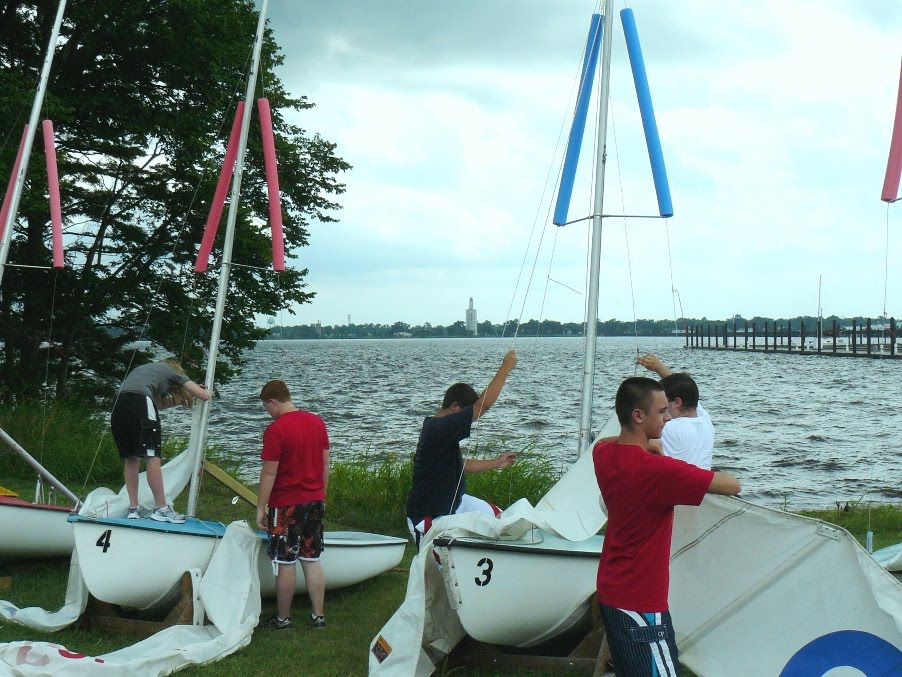
photo at right: New Bern High School NJROTC cadets rigging up FJs #1 thru #4 at Bridgeton Harbor... you can see New Bern's grain elevator on the far bank of the river.

This summer's goal has been to not only gain sailing time, but also to cover some academics on technical skills like radio communication, general vessel structure, and a few other things we have not had a chance to cover in the basic course this past spring.

We have done that... today we practiced radio protocol, studied some technical aspects of what radio is, how it works... statements from the cadets began with "it uses electricity" and rose to the level of describing wave modulation to convey information... and what radio can do. We have used hand-held VHF radios a few times in the sailing course, and some of the cadets are ready to add it their list of skills mastered.


Yesterday (Monday) we had good winds of 10~12 knots, the FJs could plane in the gusts. It was a day that definitely rewarded good skills, and sought to punish (or at least embarrass) mistakes. Today the weather took a turn for the worse!

A rain squall caused a delay, which we used for shore lessons. The boats were ready to launch & sail by 1515 (that's quarter after 3 pm) which is still a bit sooner than we have launched in the past... we are getting better at rigging up!


The sky was partly cloudy, some growing cumulus but nothing threatening. Since there was predicted a 50-50 chance of thunderstorms, we had our weather eyes tuned up & scanning. After we got started, the wind built up to 15 ~ 18 knots out of the South-South-West, bringing real choppy conditions & solid whitecaps across the Neuse River.

Of the 4 boats launched, 3 got an hour or more of good sailing in the rising breeze; unfortunately a snafu with the last FJ launched kept them from joining the fun. We made good use of capsize training! After all capsizing is part of small-boat sailing. However the fun got a little too intense... one boat had to be towed back and all had some difficulties returning to the beach.

If you've never been in a squall on open water, it is difficult to describe. First, you can barely see anything as the rain pelts you like 100 fire hoses (and it feels like the fire hoses are pumping golf balls at you). A warm summer breeze turns chilly. The waves, which were already big enough to bounce the FJs around, grew and became malevolent... the boats become difficult to steer and the deck seems to be trying to throw you off. It would be easy to panic as Mother Nature is now trying to GET you!

However, we have trained for this. There were a few problems, which could have been serious if not handled properly. We reinforced the lesson of "always stay with the boat" and also learned how to re-evaluate priorities when simple things become difficult. Most of all, we learned that teamwork is the key.

I apologize for not having pictures of the action during the squall. 1- we were all far too busy to take pictures... 2- I don't have an underwater camera.

posted by Assistant Coach Douglas King

Sunday, May 16, 2010

Let's Race! the New Bern High School NJROTC Regatta is a success


Chaos?

Nope, just getting the fleet launched for our FIRST-EVER regatta. The New Bern NJROTC cadets were good hosts, doing the work of rigging & launching 6 Flying Juniors before the races could start.

.

.

.

.

.

.


Let the racing begin! What you can't see in this photo is four other FJs almost perfectly aligned, hidden behind FJ#2 (skippered by RTP's Willing crewed by New Bern's Carlton) and FJ#3 (Albert & Bloom).

This is the first time that our NEW sets of sails have been hoisted... they look perfect!

.

.

.

.

Bill Drechsler of New Bern supervised the actual running of the races. His team of cadets varied throughout the day (pictured here, Webster Carlton and Ciara Jones) and displayed the precisely-timed starting signals to the racers, directed the placement of buoys, and recorded the finishes.

.

.

.

.


Here (pic at left) is New Bern cadet Mi Mon skippering FJ#3. She sits high on the side to see around crew Mike Foster's famous hat. This team should have won the award for 'Biggest Smiles' during the regatta.

.

.

A minor administrative glitch with the boat rotation... All competitors sail a race in every boat, thus leveling the playing field, but we started with 10 teams, 6 boats to sail, and used a rotation matrix for 9 teams for the first race. Halfway thru the 2nd race, we managed to put together a close-enough rotation to get back on the level playing field (anybody who thinks this is easy, please contact Coach King for the matrix/array problem... you have until next year's regatta to find a better solution) and New Bern cadet Allyssa Cormican got all the teams back on the water in the correct boats for the rest of the races.

.

Matt Fesak of Bridgeton skippers FJ#6 to a bullet (first place finish). In later races, crew Sharon changed places to skipper well enough for 3rd overall in the regatta; this team also earned the Cadet's Choice award for sportsmanship & spirit.

.

.

.

.

.

.

.

Cadets Crosby & Murphy of the West Ashley NJROTC traveled all the way from Charleston SC to attend this regatta.

We hope to have a number of NJROTC sailing events in the future and look forward to sailing with these cadets again.

.

.

.

.

.

Race 3- Long ago, a wise man said "Watching sailboats race is almost as exciting as watching grass grow." Too bad he isn't watching this one. FJ#6 (Albert & Bloom) puts a squeeze on FJ#4 (Parker & Parker) at the finish line buoy (yellow ball).

This is a good example of textbook racing tactics put into practice... earlier on the last upwind leg, #6 worked at pointing high and building seperation; then bore away from the wind a little for speed to make this play.

.

.

Race 4: Here are both RTP High School team competitors in action. FJ#2 skippered by Joe David puts a "loose cover" on FJ#4 skippered by Will Willing and crewed by New Bern cadet Peter Carlton. You don't win races by using this kind of tactic, but in shifty wind conditions you can certainly LOSE races by NOT doing so!

.

.

.

.

.

Who is it that makes sure the starting line is fair? And puts the windward mark squarely to windward? The chase boat & crew, of course! We also take pictures when not too busy with race duties, hopefully we will post video of some of the racing action in the near future .

.

.

.

.

.

.

Maneuvering for the start of Race 5, FJ#2 with the father & daughter team of Sarah & Eddy Parker, FJ#1 skippered in this race by Matthew Fesak of Bridgeton, and FJ#6 with New Bern cadet Jeff Glover (crew) and Mike Foster (skipper) of New Bern.

.

.

.

.


.
Last weekend saw cannons firing in the re-enactment of the Civil War Battle of New Bern, here the river is scene of a more quiet but very intense battle under sail.
.

With the historic New Bern sky line in the background, skipper Doug Longhini and crew Sergio Lopez (New Bern NJROTC cadet) roll their boat thru one last quick tack at the finish line mark (yellow ball). They are so close, but FJ#3 beats them across the line in Race 6.

.

.

The RTP High School team members Evan Renoud (skipper) and Joe Thomas (crew) won this race, and the regatta. They posted 1 more bullet (first place finish) than Team Bornarth but also sailed a bit more consistently, with no finish worse than 3rd

Evan crewed in most of the races but he obviously knows how to work that steering thing, too.

.

.

.

.

.

The race course itself demands skill, to finish at all is a victory. Skipper Doug Longhini's grin shows the satisfaction of sailing a close, hard fought race.

.

.

.

.

.

.

.

Father & daughter team of Dan & Katie Bornarth. Two redheads in the boat spell trouble... for the other competitors! This photo shows them preparing for the start of Race 7 which they won.

Dan & Katie earned a 2nd place in the regatta overall. They beat the winning team of RTP high-schoolers Joe David & Evan Renoud twice during the regatta.

.

.

.

.

Guest team of Albert & Bloom sail out to the starting line in Race 7.

.

.

.

.

.

.

.

.

.

.

Blackbeard Sailing Club member Mark Brennesholtz skippers FJ#3 preparing for Race 8, with New Bern cadet Colton Craig as crew.

All ten races were completed in light shifty winds; but as you can see the FJs were moving pretty well (look at the bow wave here) and the races were won more by sharp sailing & tactics than by the dreaded summer 'drifting matches.'


A big THANK YOU to Ken Gurganus of Blackbeard Sailing Club for all photos

posted by Assistant Coach Doug King

Tuesday, April 27, 2010

8th session, 2 much 2 sail

OK another day when there was TOO MUCH wind. But we had a constructive session at Bridgeton Harbor; getting some solid details in place and getting a few qualifications signed off.

.

For example, we have worked a bit on the skill of bringing a sailboat with no brakes up to a dock without breakage. However, sometimes it is also challenging to sail away from a dock. Here's the theory...

.

.

And here's the real world!

This is a great sequence to learn from. First, if you're learning to sail, you can see how sailboats don't always do what you want, or what you expect. You can see how that as the boat is cast off, it begins to move forward, then refuses to turn further and begins backing up. Look for the brief interval where the boat is sliding sideways, the centerboard has no effectiveness.


Head Coach Rezab quickly and decisively applies corrective action (steering in reverse) which also teaches us something about leadership.

Normally, we'd rather have still photos (much quicker to display) but as of right now, all we have is video.

So here is the main portion of Coach Rezab's sail. He & crew Coach Hittner perform a tack close to the camera; this is done from a reach (point of sail) to a reach because of constraints on space... not hitting the dock at 20 knots is a goal... but later they show some good tacks going close-hauled upwind between the docks. Here, it is very important to have good helm control, tacking from a close-hauled course to a close-hauled course. Turning the boat too far will give away distance already gained towards the goal upwind, turning the boat too little will leave the sails luffing & the boat will stall & slide sideways, or even stop & make sternway (again).


.

.

.


.

.

Last, we have a video of Head Coach Rezab docking the boat under challenging circumstance. Notice how the boat makes leeway as it slows, looks almost like it is skidding sideways as the centerboard loses effectiveness.


.

We have 2 sailing sessions left for the spring. With any luck, we'll have a good breeze & get a chance to practice some of what we've learned; then after that comes our regatta on Saturday May 15; then after that comes the summer sailing sessions (July). A lot to look forward to!

posted by Assistant Coach Doug King

Thanks to Coach Brian O'Flanagan for the video

Tuesday, April 13, 2010

6th session revisited... more capsize drill, pics + video

Our capsize drill session on Monday was probably the most-taped and most-photographed event outside of Hollywood. There have been 3 batches of photos handed over, and we have video of every cadet team capsizing & recovering the boat. We don't have room for all this on the web site! But we will put up a few more, along with some instructive discussion (you can't get away from it).

Cadets C_ H_ (crew) and C_ T_ (skipper) find out how far you really have heel an FJ before it will capsize (right). These boats "feel" tippy, and they heel to 20 or 30 degrees (the boat at right is heeling to about 25) quickly & easily. But it takes much more than that to pull them all the way over! And this boat has taken on water, it's stability is suffering from the free surface effect.


.

.
.

Here's another pic showing the FJ heeling even further. We're looking at it somewhat from the side, but it still appears to have tipped beyond 45 degrees... you can see the splashes where the skipper & crew fell out of the cockpit, no doubt convinced it was OVER. But the boat pulled itself upright immediately after this pic was taken.

.
On second glance, it also looks like these guys are about to lose their paddle!
.

.


The above video features cadets N_ & W_, view is from the deck side. They (like so many others) underestimate what it takes to capsize the boat... it dumps them out & rocks back upright... but they go on to perform quite well on all other counts. We get a good close-up of crew Cadet N_ making a good throw-able coil out of the righting line, and accurately lobbing it over the up-side gunwhale. We can't see skipper Cadet C_ but he is very prompt in getting into action with the centerboard & righting line, you can see the line go taut & the boat start rotating upright.

Here's an important point- several teams did not work together on doing the 'scoop' to get the crew aboard. Most did not communicate (difficult in the noisy pool environment, it's true... but won't exactly be quiet in a storm out on the river), and this led to bad timing and worse technique. Some crews were a detriment to the skipper's efforts, pulling back against the boat to hold it capsized. Others scooped into the boat causing no difficulty.


Photo (right) of Head Coach Rezab showing how it's done... correctly, that is... pressure still on the centerboard, holding tension on the righting line. Cadet Fouts has done a good job getting in towards the center of the boat & staying low.

Another important point along the same lines... the purpose of the 'scoop' is to have a person aboard to take control of the boat! Remember, you just capsized... persumably, conditions are difficult, windy or choppy... and the boat will require active measures to tame it.

.

Now that we've beaten the subject of CAPSIZING totally to death & beyond, how about one more video...


This last video shows Cadets C_ & C_. They make one very serious... potentially deadly, in fact... mistake at the beginning, and then perform efficiently and flawlessly from then on. We are viewing from the hull/centerboard side, so the video does not show C_ as crew, but you can see the results: righting line comes hurtling over the gunwhale; as the boat comes upright he is low & to the middle of the boat having done a perfect 'scoop' and he then both helps the skipper and moves to take control of the boat.

THINGS WE LEARNED-

... FJs are not as tippy as many think (however, you should not stand on, or try to walk across, the foredeck of one)

... Centerboards have several purposes

... Even without the mainsail attached, the boom is something to watch out for

... We can handle a capsize -IF- we keep the drill procedure in mind & work together

.

(photo at right) Cadet F_ as crew, assisting Sailing Squad XO C_ (as skipper) climbing aboard over the transom after successfully demonstrating an alternate righting procedure for a capsized FJ.


Coach King Says- any cadet who wants the entire video of 12 Apr 2010's capsize drill may have it for the asking. It contains at least some footage of every capsize done by every cadet present. It's about 40 minutes, unedited.

Thanks again to Coach Brian O'Flanagan for shooting the video
Thanks also to Mr. Herm Schiller for some of the still photos

posted by Assistant Coach Doug King