Tuesday, November 6, 2012

Basic Maneuvers & Evolutions 1... TACKING


.

When we go sailing, we have to DO a bunch of stuff. In order to get things done, we need to KNOW how to do them, which entails knowing the words for the things we do and things we do them with.

Let's assume you already know at least a dozen funny boat words and you've already been part of the sailing action. Let's make sure that you know what we are trying to DO so you can take a better part in the action!

the TACK
The very first time you sail, unless you sail all the way across the river and stop at the shore over there, you will have to turn around.

"Tacking" is a turn, but a sailboat is not tacking everytime it turns.

This boat is turning but it  is NOT "tacking."

Don't be confused by the various ways the word 'tack' is used... a boat is on a tack (in this diagram, on starboard tack because the wind is on it's starboard side). This boat is turning, but it is not tacking. It's not using thumb-tacks either !!

.


In order to TACK the boat turns into the wind, and keeps turning until it is sailing with the wind on it's other side.

The first step is to make sure everybody is ready, so the skipper gives the preparatory command "Ready About." (translation: this boat is going to tack, so get ready and report back). The crews' jobs including acting as lookout, and in small boats, keeping the boat as level as possible. When TACKING the crews' job will be to shift the jib sheets (link), also.

The crew reports "Ready" and the helmsman (the skipper on small boats) will put the tiller -towards- the sail. The boat turns bow-to-wind or head-to-wind and will stop if it does not continue to turn until the sails fill on the new side.


 Let's look at TACKING in real life


.
With a fixed reference point, it's easier to see the boat turning. Here is one of our Javelins sailing along, close-hauled on starboard tack (make sure you know what that means!).

The wind is blowing from right to left in this photo. At this point, with a dock close ahead, the crew should be ready to tack.


.


.


The skipper tells the crew "Helm is a-lee" meaning that the tiller is over and the boat is beginnning to turn into the wind

If the boat stops turning at this point, it will coast to a stop and then drift out of control


.


.


The boat continues to turn.

At this point, the skipper & crew should be shifting sides. The crew should also be getting ready with the new jib sheet, having already released the old jib sheet

If the boat stops turning at this point, or if the sheets are not being handled correctly, it will coast to a stop and drift out of control. How do we know this is what will happen? Because we have done so, many times!


.


Sails are full on the new tack... boat is sailing again, now close-hauled on port tack.


Congratulations! You have now TACKED a sailboat.

This is one of the primary skills of sailing, and we are looking forward to practicing for real, out on the water!

Tuesday, October 23, 2012

6th session Fall 2012... light wind

.


Today we had doubts about sailing... cloudy, chilly, etc etc... but the sun came out and there was just enough wind. This is our sixth sailing session of the semester.

We still have much to learn. For example, don't let go of the halyard! This is the 2nd time this has happened this semester... what, are you all copying from each other?!? Seriously, this can be a disabling mistake.

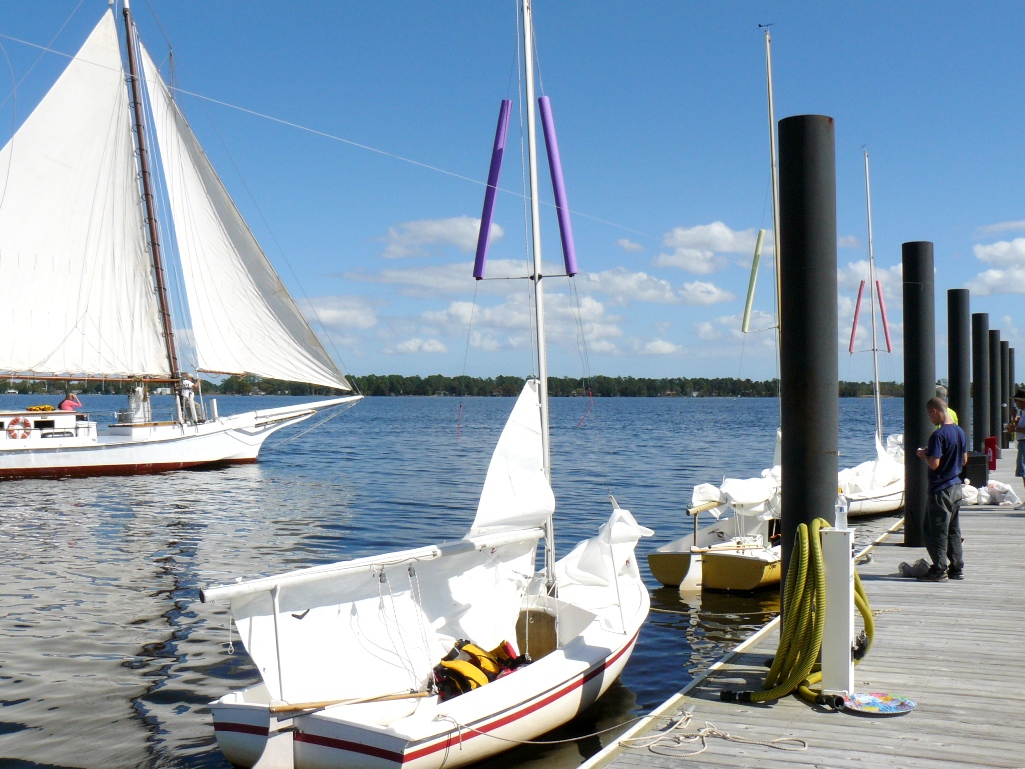
These cadets can fix their mistake, and they have done right in securing the sails into the boat, and keeping the boat's painter (bow-line) on the dock. However the sails could be a little better tucked in... and it's better to NOT LET GO of the HALYARD in the first place!


Meanwhile, over at the Flying Juniors, three crews are hard at work getting their vessels rigged & underway.

We also got the 5-O-5 sailing today, with 2 "blue book" sailors... cadets who have completed the basic sailing course and are making serious progress on the advanced level.


.


Here we are going to show some pretty good sailing photos.

This boat has just done "bearing away" to pass the coach boat; the sails are eased slightly from close-hauled.


.


.


Umm, guys... look where you're going!

Another FJ passing the coach boat after doing "Baby Ducks."


.


.

Maybe we should add "pass in review" to the sailing drill. Here goes our Javelin #1, with it's crisp & aerodynamically-efficient new sails. Note how the crew is attentive to sails & wind, which is good.


.


.


 Yes, this confident skipper is a beginner sailor. Yes, the boom vang is too loose... we'll get to that, but the basic sailing lessons are covered!

One thing that these sailors do well is keep their weight where it should be. Many of our sailing cadets want to sit in the back, which drags the transom and lets water run in.


.


Here's 2 of the FJs returning to base...
No wait, that's a painting by the Impressionist master Monet...


.


.


THIS is two of our FJs returning after sailing practice.


Seriously, another good day on the water... we are -almost- at the point of declaring success, most of us are getting to be pretty good sailors... hopefully the weather will give us a few more turns to not only prove our skills, but also have fun!

.... ... posted by Assistant Coach Douglas King

Tuesday, October 16, 2012

sailing... Baby Duck drill !!

.


Weather- cloudy, cool, threatening thunderstorms, winds 5~6 kt NW... nice day for a sail!

Here's what an actual Baby Duck drill looks like

It may seem pretty late in the semester, but this is still only the 5th sailing session for our basic sailors... well, some got in a lot of extra practice yesterday in OpSail MUMfest... so most of us are actually learning pretty fast!

.


One FJ wandering a bit off course after a tack, Javelin #3 (yellow hull) about to tack into position... This is demonstrating how well you can (or can't!) control the boat.

Review- we've learned terminology, rigging (and unrigging), Points of Sail, Tacking... we should be at least a little familiar with getting underway and docking, since we've been doing those things each time but not formally teaching them... and you should know a -lot- of safety points to go with each stage of all these actions!


.


We sailed 3 FJs and 3 Javelins... we -should- have pictures of 6 boats sailing, then... This photo is the only one in which all 6 boas were close enough together to get them in a picture! Kinda shows what we can do better, eh?


"To Do" list-
Knots- learn to tie a bowline, cleat hitch, figure-8, and clove hitch...
Gybing- it's like tacking only different, and you have to be a good deal more assertive about control of helm & sheet
STOPPING (link)- this is mandatory, will be applied to docking and to man-overboard practice...no you can't jump in!
Right-Of-Way rules (link)- when we sail in close quarters with other boats (which will be almost always) then we need to know who dodges whom. Collision = FAIL for both skippers!
Sailing Drills (link)- weather permitting, we will sail a couple more drills to improve and demonstrate sailing skills for both skippers & crews.


.

We will continue to work on steering (and the physics of all forces in play to make a vessel turn or go straight), in fact this "steering" is a complex subject which will always have new points to learn for the most advanced sailor

Speaking of advanced sailors; where was our 5O5?

Infested with fire ants! Do Not Touch!!


.


.

The coaches do a lot of work and bring a lot of equipment ... including a First Aid Kit which would be good for treating fire ant bite... but did not bring a can of RAID... seriously we need to nuke these things!

But here's a look at what the coaches were doing, aside from carefully supervising: Head Coach Rezab and Coach Murphy working at fixing a wind indicator at the top of the mast. Also see the bottom of Javelin #1 coated with anti-fouling paint, done before launching this spring. Look Ma, no barnacles! Yeah, tell us coaches to stop slacking off, go ahead...

In all, this sailing session was a big success and hopefully will be followed up by even bigger success.

... posted by Assistant Coach Douglas King


.

Monday, October 15, 2012

Operation MUMfest Sail 2012

.

Last year was the first Sailing Demonstration for New Bern's MUMfest (link). This year, we repeated this operation -but- (listen carefully here) two of our three boats were skippered by cadets! This is a big step up. Congratulations to those who have reached this level of skill!

We could have done better at close-quarters maneuvering; and at keeping the boats in close order to begin with. However the basics were all in place, and that is most important. We could have used more wind too, but that must be accomplished at a higher level.

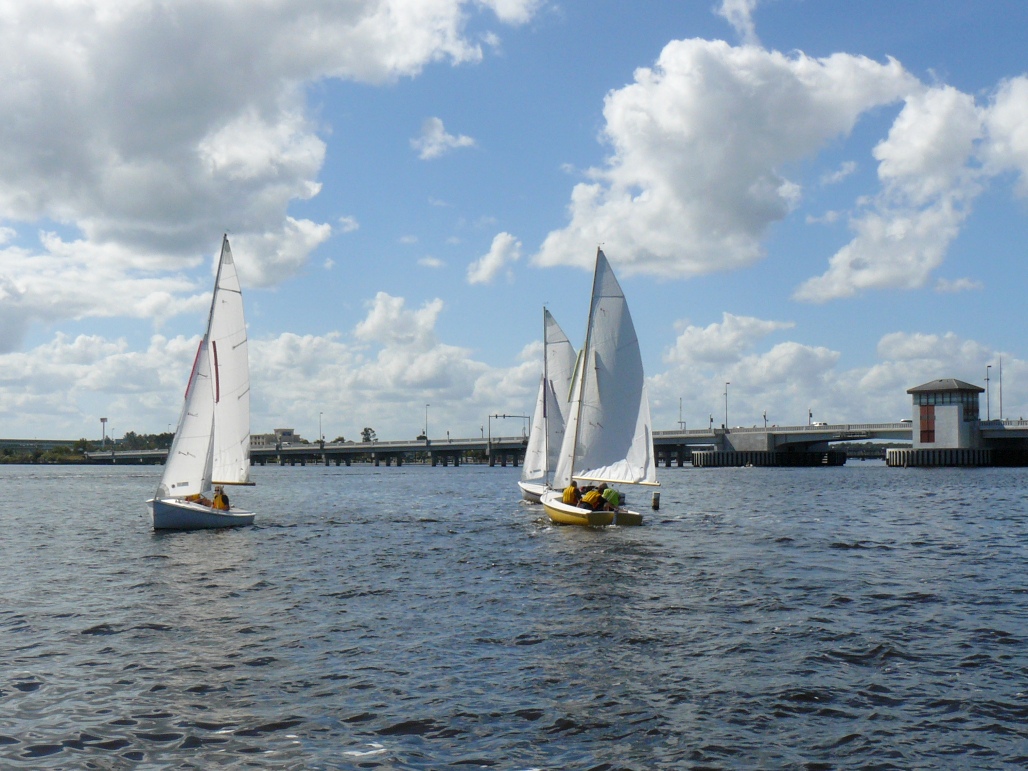
Destination: Downtown New Bern! But wait... don't we have 3 boats? Where is the third boat?!? And aren't these 2 kinda far apart to be a "fleet?" Hey don't complain... we're working on the basics here. Can you see the Ferris Wheel?


.

Our mission was to sail up close enough to the waterfront that spectators on shore could see the activity, and perform maneuvers in unison so it would look like more than just some random boats sailing by. But we don't want to get TOO close, especially at parts of Union Point where there are underwater remains of New Bern's industrial past just waiting to crunch & munch our nice fiberglass.


Speaking of crunch... here is a tour boat waiting to pass our fleet. Those of you who were HERE will remember it as much closer than it looks... which is true, photos never quite capture the actual distance between objects...

.

All the boats were well sailed on a basic level...  points of sail were accurately followed, helm steady & sails trimmed... maneuvers were done relatively smoothly... very rarely did one of our boats get stuck "in irons" during this exercise. We've made good progress this semester, we now know a lot of terminology, we can rig & unrig the boats, and we can really sail! Are we done? Umm, no. We still have some more skills to learn & demonstrate including CAPSIZE (link) and man-overboard recovery, and we need to learn the Right-Of-Way rules (link).


.


Look Ma! We're all CLOSE TOGETHER just like da Coach keeps tellin' us !!!


.


.


This is as close as we got to close-order drill... tacking in unison? Hmmmmm. Let's work on this, it's not that difficult!


.


.


Time for a lunch break! The cadets had a chance to enjoy Mumfest for themselves, after demonstrating how to dock a sailboat (this entails "how to stop" link).  Notice how easy it is to keep the boats nice & close together... when tied to the dock...

Meanwhile, New Bern's historic vessel the skipjack Ada Mae (link) sails by


.


.

Great! Here's a photo of all our MUMfest fleet... can you tell what Point of Sail they're on? The wind is light but the boats are still moving. Accurate sail trim is the key to making a sailboat go!!


.

Here's two of our fleet (ahem) sailing past New Bern landmark Persimmons Restaurant. At one point we had a crowd waving & cheering for us sailing past, or maybe they were rooting for the tour boat.

Anyway, after this, it's time to sail back to our base at Bridgeton Harbor.


.


 Waterfront pastime... skipping stones
.
Maybe some time we will go into the physics of how a stone can skip instead of just sinking like a... umm...  rock


The basic sailors today doubled their experience... after all this is only the 5th sailing session for this semester. How many more will we have? Well, we hope to have another tomorrow! R U ready?

... posted by Assistant Coach Douglas King

Monday, October 1, 2012

New (well, new to us) Boat ! ! !

.


A sincere THANK YOU to our latest supporter

Mr. W.A. is a Navy veteran, serving in the SeaBees and deploying to Korea and the P.I.

He donated his 14 ft "Tern" sailboat & trailer, along with lots of fittings & gear, to our program. You can see this boat is very similar to the Flying Juniors we have, and we will put it good use.

Getting More Experience...

.


Light easterly wind, gloomy overcast skies, high school student sailors, some boats... put 'em all together!

We had more boats sailing... 2 of the FJs and all 3 Javelins. The FJ sailors had a pretty good game for awhile, plus we had 2 new sailors take the helm of these responsive little boats.

Meanwhile, practice continues in the Javelins with coaches assistance.


.


.

Here's an example of what we're learning-
Two boats on 2 different Points Of Sail, looks like there might be some risk of a collision coming up! However, the yellow-hulled boat (on right) is to leeward of the red striped Javelin and thus has Right-Of-Way. The red striped boat turned to starboard and passed safely astern of the yellow boat.


.


Another demonstration, if any is needed at all, of how the Flying Juniors are the sports cars. FJ#9 goes swooping past a Javelin

.
And here's something we're apparently NOT learning: sitting in the far back of the boat is a poor way to steer... ... come to think of it, those FJ sailors would do better to move their weight a little forward, too.


.

.


Congrats to our newest FJ skipper!


.


.
Javelin sailors with Coach Murphy. The sails are set properly and as you can see by the bow wave, the boat is moving pretty well for light wind.

This boat is on a CLOSE REACH on Starboard Tack. They could go CLOSE-HAULED by turning slightly upwind (toward the camera) and pulling the sails in tighter.


.

.
Back at the dock, unrigging the boat. Just a brief review, looking at this picture- the main halyard has been uncleated, the mainsail has been lowered, and the crew is loosening the outhaul so they can take the mainsail off the boom. They will also remove the rudder, lower the jib, coil & hang up all the lines, and stow the sails properly.


(photo by Jerry Rezab)


See the blue sky in this last photo? At the end of the day, the sun came out! Maybe somebody up there likes for us to go sailing!!


... posted by Assistant Coach Douglas King

Monday, September 24, 2012

3rd session, 2nd sail for most

.


Another beautiful day on the river, not as much wind as last time. Today we sailed all 3 Javelins (again with the coaches aboard) and 3 of our FJs. Come on you Javelin sailors, get it in gear!! You should be motivated to learn to sail well enough to not need hints and reminders and a coach sitting right next to you!


This picture is not a good example to follow for sail setting in light wind. As you can see on the water's surface, there -IS- wind. These cadets had a bit of a distraction from working on perfect sailing, though.

One of the privileges of being an advanced sailor is getting to sail the FJs which are much sportier than the Javelins, and picking your crew!


Today's on-water exercise was to demonstrate skipper & crew tasks on all points of sail, tacking, and bringing the boat to a stop. Most sailors also had a chance to experience a GYBE (maneuver) and see the difference between gybing and tacking.

Sailing students need to learn many things. They need to learn the terminology (link to lesson), to begin speaking the "language of the sea." They need to know the major parts of the boat, and how these parts work. They need to know the points of sail (link to lesson) and the basic maneuvers, starting with TACKING.


.

Some things just naturally irritate all the sailing coaches. One is the mistaken idea that pulling the sails in tight will make the boat go fast.


Coach Murphy has obviously gotten these cadets over that mistake. What point of sail are they on?


.


.
One of the lessons we learned today is DON'T LET THE MAIN HALYARD GO UP THE MAST !!!


Every sailing cadet should get their sailing textbook, available from LCDR Tyson. Every sailing cadet should also work on completing their written assignments, due before next Monday. Some hard-working cadets have earned extra credit by turning theirs in early!


And think about Mumfest... we have a sailing event to plan and execute in  just a few more weeks. (link to last years Mumfest) This is the task of the Sailing Squad Commander, and the advanced sailors. Those motivated to 1- get more on-water experience, and 2- demonstrate strong potential to become advanced sailors, should be part of the planning and the event itself.

...posted by Assistant Coach Douglas King