Monday, March 7, 2016

SPLASH! ... capsize at the 'Y'

.


Here is how it starts: bringing an FJ to the Twin Rivers YMCA pool.

The coaches get everything ready.


.


Then the class shows up


.


This time of year, the pool is covered by a "bubble" roof.

We have to carry the boat in through a door.


.


To fit in thru the door, the FJ hull is tipped on it's side, and one group of cadets hands it in to another group waiting inside.


.
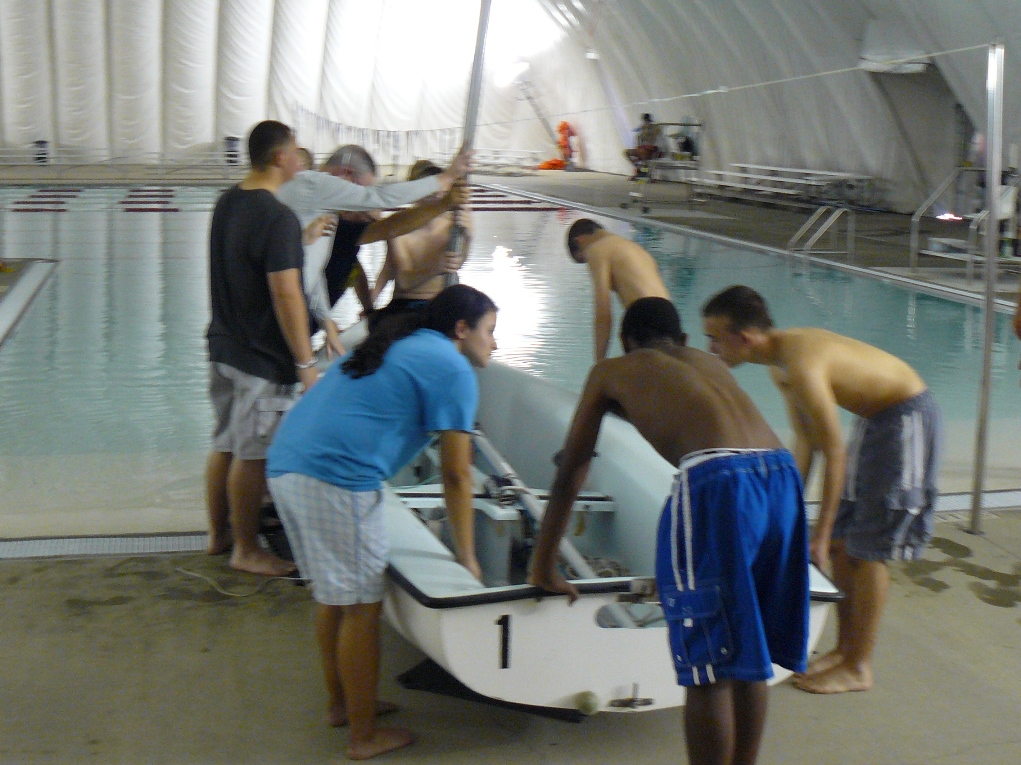


Now we have to put up the mast & rig the boat. What are the names of all these parts, again?


.


Now we're all ready! Who is going to go first?

We have a few advanced sailors in the class this spring, and they actually run the drill.


.


No wind inside the "bubble" so no sails. However, the skipper & crew (beginner sailors) are in position.

 In the water, an advanced sailor swims the boat into position. Another advanced sailor cadet is on the foredeck ready to pull the boat into a capsize


.


 Into the water!

FJs get very unstable when a person is standing on the foredeck, so this part is easy.


.


You never know how people will react when suddenly dumped into deep water. One big reason to practice is so that if it happens in real life the shock effect will be much less.


.


 Step 1- make sure all persons on board are OK


.


Step 2- get control of the boat

This means one person (usually the skipper) holds the centerboard to ensure the boat does not turn completely over (turtled).


 .


 The crew has a job also, tossing the bow line (painter) over the gunwhale to give the skipper greater leverage, to ensure the sheets are not tangled and the sails free, and to "scoop" into the boat as it comes upright.


 .


 Step 3- the boat is upright, the crew is on board, help the skipper in and sail away!


 .


Everybody in the sailing class got their chance to show they have learned the CAPSIZE DRILL


.


Then, as always, there is work to do. We put everything away properly, being 'squared away' is one of the marks of a real sailor.

In this case, the first step is to drain the water out of the boat!

 Next week, we hope to show what we've learned about rigging and sailing... everybody remember TACKING?  ... but hopefully not capsizing because the river is still cold water.

... posted by Assistant Coach Douglas King


.

Thursday, March 3, 2016

A Good Beginning

.


What do you do with a sailing class when the students are ready to go, but the weather is not? Monday was cold and windy, in particular the river is still dangerously cold (water temp around 42 degrees). Gusts approaching 30mph made teaching beginner sailing impossible.

(photo)Chaos? Not really, just getting the sailing gear out of storage. Learning to put on a lifejacket, and adjust it properly, is part of "gearing up."


.


We've already learned a little about care of sails, now we put it to use: Stored dry & rolled neatly, the sails are never dragged or crumpled. Both the Javelins and the FJs have relatively new sails, and we use them hard but we take good care of them.


.


Now we're out on the water! We learned a little about our sailing area, and weather driving our winds; now we are getting organized to actually get on the boats!


.


.


We have rigged a boat in the parking lot, now what is different about doing while afloat? For one thing, the boat actually rocks & heels!

This is the tricky thing about any practical subject: for every single lesson, there are at least a dozen smaller lessons within that one, about how you actually achieve the goal. In one way, it's how we have made so much progress over the centuries!


.


Now we are underway!

Er, umm, not really underway so much, but our lesson is under way! Today we practiced how to steer, how to handle the sails, and a bit of teamwork in making the boat GO.

We learned a lot today without ever leaving the dock, which was much safer than going out on the river.

One specific part of the lesson is TACKING


.


A good way to learn is to WATCH others, then you can avoid mistakes! These sailing cadets patiently await their turn to practice steering, handling the sheets, and TACKING. When they got into the Javelins, they did an outstanding job!


This coming Monday, March 7, we will go to the Twin Rivers YMCA in New Bern for capsize drill. After that, hopefully the river water will have warmed up a bit and we'll get some good weather for really sailing (and not capsizing).

... posted by Assistant Coach Douglas King
... photos by Coach John Jackson


Monday, February 22, 2016

Sailing class begins!

.


Actually, our sailing class began 2 weeks ago.

Today we pulled the Javelins and half our FJs (Flying Juniors) (link) out of winter storage. The coaches have already been at work (especially Head Coach Rezab) preparing the rigs, painting & fiberglassing, etc etc. Now the cadets do some "hands on" work and get them ready to sail!


We also have a written assignment, help for which can be found HERE (link). Parts of the boat, terminology, and basic sailing practices... and of course, safety guidelines... should already be familiar.

Next week (Feb 29) we will carry out some sailing practice in the boats with coaches supervision. On March 7 we will have CAPSIZE DRILL (link) at Twin Rivers YMCA. After that, we'll see who is becoming a real sailor!

... posted by Assistant Coach Douglas King
... photo by Coach John Jackson


.

Thursday, October 29, 2015

Outstanding... Gloomy days, great sailing !!!

.


Despite cloudy weather, we've had some great sailing days this fall... particularly the MumFest sailing demonstration. Here you can see all three Javelins, skipperd and crewed by cadets, sailing wing-and-wing (a difficult point of sail) past New Bern landmark Persimmons Restaurant.


 .


The fleet drew a crowd to the railing at Union Point. Due to the wind direction, the fleet had to sail close-hauled almost directly alongside the jetty and then run downwind  for the demonstration. The combination of quick, coordinated tacks in one direction, and gybes in the other, showed the cadets' high level of skill.

Well done, MumFest sailors!


.


On another gloomy day, but with good winds, the NJROTC sailors practice their skills more. Here we see one of the experienced skippers with Coach Jackson learning how mainsail trim affects steering (in FJs and Javelins, the skipper both steers and trims the mainsheet).


.


At this point in the program, we perform sailing drills in close quarters. Skilled boat-handling and knowledge of the right-of-way rules is essential.


.


The Javelins are heavier and beamier than the FJs, which is why we call the FJs our 'sports cars.' But given the skill and determination to get the best performance, the Javelins can really move. Here we see an advanced cadet sailor hiking to control heeling while a beginner (although one with past sailing experience) skippers, driving the boat hard.


.


We only have a few more sailing days this fall, the class is going well and most of the new sailors have already reached a level where they can pass the final sailing drills. And having a great time, too!


.            posted by Assistant Sailing Coach Douglas King


.

Monday, September 7, 2015

Sailing Begins, Fall 2015

.


Sailing class has begun! Monday afternoons are now officially for SAILING!

.


Head Sailing Coach Jerry Rezab demonstrates rope & knot skills. Yes, this is a real class and while it not really possible to flunk, it is certainly possible to, shall we say, not pass. 

 .


.


At our next class session all sailing cadets will be expected to know the knots, and the terminology, and the parts of the boats.  Most days, we will not need to step the mast and raise it, but we -WILL- need to be able to rig the boats correctly before we can expect to sail!

.


.


Our basic sailing lessons are summarized on-line, here (link). Do you remember the difference between 'Standing Rigging' and 'Running Rigging'?? The names of all the parts of the boat are important. Teamwork is also important, and correct terminology makes it easier to work together efficiently.


.


.


The whole class got practice at least some of the skills we will need. Before going out on the water for real, we need to have some ability and some confidence in this new and potentially dangerous environment.
.


.
 

 Photos by Assistant Coach Fred Cornford
.... ... posted by Assistant Coach Douglas King


.

Tuesday, April 21, 2015

More wind!

.


Many sailing classes do not get the experience of sailing in strong wind. This semester, we are getting LOTS of practice in reefing the mainsails, handling the boat in big waves, and the fun of going fast.

In this photo, both skippers are Advanced Sailing cadets... passed basic sailing earlier in their careers! Beginners, step up!! You do not earn a medal for being crew!

 We are getting close to the end of the semester. We have 4 sailing days left, and this leaves little time for practicing sailing drills.


 .


 Lesson to be learned from this photo- when in doubt, let it out. These cadets are happily sailing along on a broad reach, in other words going down wind, with their sails pulled in too tight. The boat is going slower than it should, and it will be more difficult to steer.


.


 Here is a boat being well sailed. Also on a broad reach, the sails are eased out and the boat is tearing along.

Note the helmsman: sitting forward in the boat, using the hiking stick (tiller extension).


Crash crew ready!


 .


These two boats have just tacked. The white Javelin has her jib trimmed in, and the sail is starting to pull the bow away from the wind as well as pulling the boat forward. In difficult situation, using both sails properly makes it look easy!

A minute or so after this photo, the yellow boat pulled ahead due to her skipper's better steering.


.


A good afternoon on the water! Coach Murphy did great at helping our sailors improve their skills.


As always, there is a bit of work to do. Sails rolled and stowed properly, the boat's rigging needs to be secured, rudders taken off and covered, and more.

Yes sailing takes work, but it builds teamwork and leadership to get these tasks accomplished smoothly.


... ... posted by Assistant Coach Douglas King

Wednesday, April 15, 2015

Sailing... yes we go!

.


This Tuesday was cool & breezy. The river was a solid whitecaps, the railroad bridge was a potentially hazardous lee shore. We had a small but well prepared group of cadets, and our small fleet of Javelins went out sailing!


.


The advanced cadets usually sail FJs, today they were assigned to take beginners out as crew. Unfortunately the beginners are still not comfortably familiar with the details of rigging & hoisting the sails yet!


.


Due to the strong winds, we "reefed" the mainsails as we hoisted them. This makes the task slightly more complex.

"Reefing" a sail is a way of making it smaller.


.


The assignment was to carry out The Pipeline (link) sailing drill. This is an exercise in sailing upwind, tacking, and sailing close-hauled.  In this photo, they have completed one round of The Pipeline and are getting ready to start another drill.


.


Here we see the coach boat flying the 'L' flag (Lima). Officially this means "come within hailing distance," we use to signal all student boats to come close to the coach boat. It is a good way to start a sailing drill, especially the Baby Ducks drill.


.


Great shot of our boats with the historic church steeple in the background.

Even when the wind is strong and the water is choppy, a sailor must be able to keep his vessel under control. He must be able to sail to a destination, to steer handily or to stop at a given spot, and of course always follow the Navigation Rules including right-of-way. Our advanced cadets proved they can do this, our beginner sailors have seen a great example of what it all means. And they have good experience as crew, which is an important part of the job!


... photos courtesy of Coach Fred Cornford
... posted by Assistant Coach Douglas King


.