Monday, April 10, 2017

Good breeze, good sailing... good day!

.


This afternoon was a bit windy, and we had a GREAT sailing session. We added one new skill, STOPPING (link) and we practiced Points of Sail and Tacking. We did a brief Baby Duck drill, so that is going to count towards the sailing qualification.

Today we got the boats rigged fairly quickly and efficiently... by this point in the class, the students should know all the terminology and all the knots!


.


Two New Bern NJROTC cadets rigging the mainsail on their Javelin. These beginners sailed with a coach, but they might be ready for independent cruising after today!


.


 It was windy enough today that the mainsails were "reefed." This means to tie off the bottom portion of the sail and make it smaller, so that the boat is easier to control in strong winds.


.


Two of the Javelins tacking. The near boat (sometimes called Red Stripe Jr.) has just passed head-to-wind and you can see the jib starting to blow past the mast. It's important to begin a tack with good speed, and to control the boat thru the turn.

We had several failed tacks this afternoon, but we don't need to show photos of that.


.


Sailing along on a close reach, on port tack. The mainsail could be pulled in a little tighter, but the boat is moving well.


.


This looks like a close call, but it really was not. The yellow boat on the left is in the middle of a tack,  the white boat is under good control on a beam reach. You can see the reef 'tucked in' along the boom.


.


These pictures do not convey the boisterous, bumpy conditions of sailing today. A southerly wind was reinforced by a sea breeze, building up to have steady whitecaps (10~12 kts) and a foot to two feet of choppy waves.

These cadets with Coach John Jackson did a good job this afternoon. Photos of sailing always make it look more calm (and relaxing) than it really is!


.
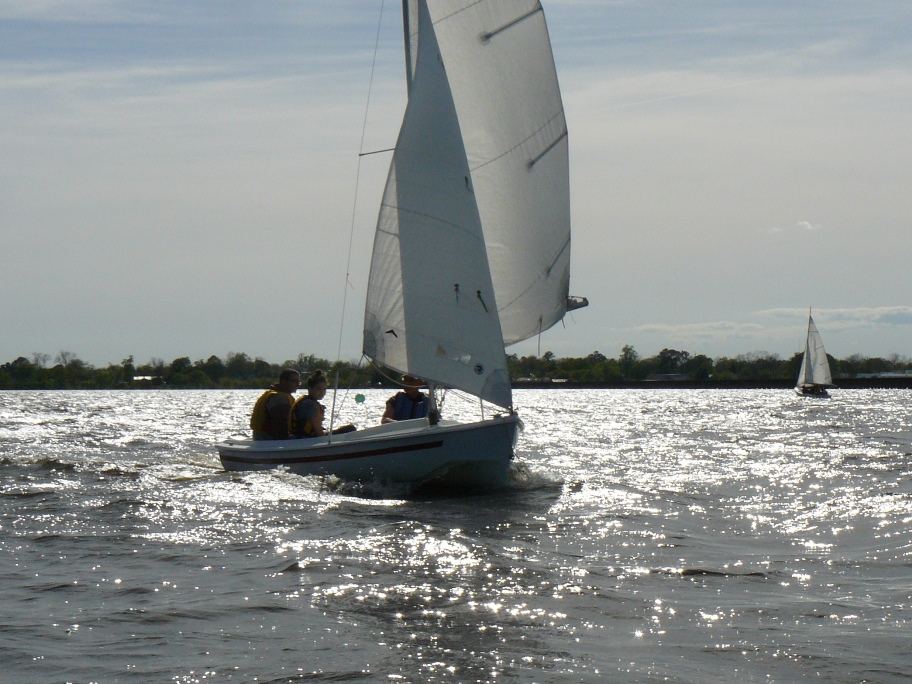


 Sailing wing-and-wing, or on a RUN (point of sail).

This is faster than letting the jib flop around behind the mainsail, and helps make the boat easier to steer down wind, too.


.


Now we're doing the BABY DUCK drill (link)... can you see the boats behind? They are doing a good job following!

This is a good exercise, requiring all the skills we have learned so far, and gives the coaches a good chance to either give feedback or to relax and enjoy the sail.


.


Here is one of the few photos that show the waves... the water surface was somewhat rough. The waves make steering a bit more difficult, and make 'working the boat' a balancing act.


.


And, as always, the day comes to a close and we have to unrig the boats.

This was both a very good practice session, and a lot of fun. Well done!


... posted by Assistant Coach Douglas King


.

Tuesday, April 4, 2017

Rough weather day- we practice some basics

.


As you'll see in the photos, this past session was held under threatening skies and strong winds.

We are getting familiar with rigging the boat, but it's more challenging when the wind is trying to tug the sail out of your hands


.


Once the boat was rigged, we kept it tethered to the dock in such a way that we could swing it back and forth with the dock lines. The cadets practiced steering and handling the sails, without the risk of a capsize or of damaging the boat, if they make a mistake or respond a bit too slowly to gusts.

In this photo, the crew is having difficulty getting the jib trimmed. The sail flapping was very loud, making communication difficult at a time when it is needed most!


.


This boat is CLOSE REACHing. You can see the sails are full, and are slightly eased: the mainsail and boom are not over the transom. The jib is trimmed correctly for this point of sail.

Two of the skills we practiced today was the correct position to sit in the boat, and handling the mainsheet "hand-to-hand" while steering at the same time.


.


Even with the sails fully eased and flapping, the boat is heeling in the strong wind (approx 20mph).  Is it possible to sail in these conditions? Yes, but it is not a game for beginners, the skipper must -know- all the points of sail, the maneuvers, -always- maintain communication with the crew, have a quick & correct response to waves & gusts, and think ahead to avoid problems.


.


The Javelins are good boats for this kind of teaching. They are built tough and they are stable, but they are also responsive enough to give the student a good feel for sailing. There is a LOT to remember, and so getting familiar with the basics of steering with a tiller (or the hiking stick... better!) and handling the sheets will help.


These two smaller diagrams show how this exercise was set up.


 When the sails are full, the boat is REALLY pulling hard... a sign that the sailors are doing it right!


.


The line handling crew needed strength and attention to detail... but they did their job well and maintained high morale. Maybe this part of the drill was fun, too!


Hopefully we will hold real sailing drills next Monday. We will continue working on sailing the 'Points Of Sail' and on the basic maneuver TACKING (link), and hopefully will also practice bringing the boat to a stop under sail.


In fact, it would be very helpful to study our On-Line Lessons (link) (hint hint). There is a link to this Table of Contents in our list of links at the upper left of this web page.

... posted by Assistant Coach Douglas King


.

Monday, March 13, 2017

winter comes to sailing... cancelled

.


Unfortunately, we lose a few days every semester because of bad weather. Although the coaches worked today to launch and dock the Javelins, it was too cold & windy... threatening rain, also... for students sailing.

It's a shame, and ironic because weather has been so mild this winter. We've had many days that would have been GREAT for sailing... but not today.


Where are we in the class?


We've learned a lot. For review, got to the Sailing Lessons Table of Contents (link).


We should know the knots.


.


We should know the parts of the boat. We especially need to know about SHEETS and HALYARDS, and how to rig the sails. The class has had several sessions of practice on this, and today we would have been doing it for real, on the water.


This class should be ready to begin practicing sailing the boat to a goal.


This means that for our next class, we should know the points of sail.

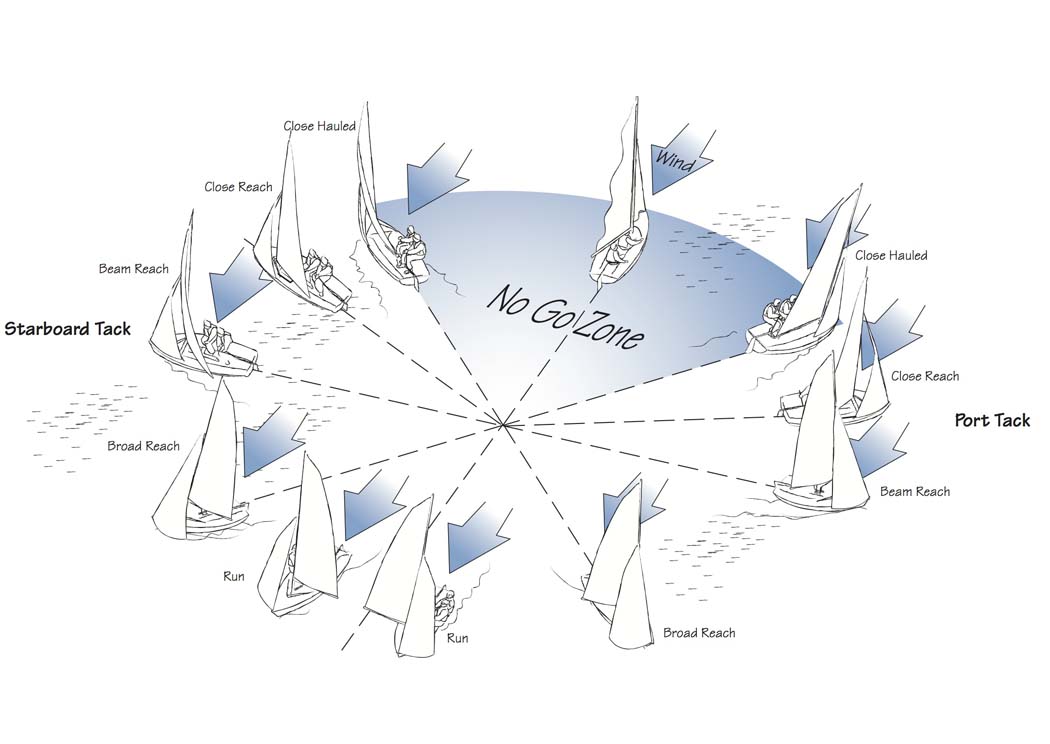
Note the difference between port tack and starboard tack. On starboard tack, the wind is coming over the starboard side of the boat.

One way to remember "Close-Hauled" is that the sails are hauled in tight (close to the center). A boat can be close-hauled on either port tack or starboard tack.


We should also know our first basic maneuver TACKING. Here is a brief lesson (link) on this.

See you next time!

... posted by Assistant Coach Douglas King


.


Tuesday, March 7, 2017

Capsize! ... What do we do NOW ???

.


This Monday we held capsize practice at the Twin Rivers YMCA.

We've been learning the parts of the boat, and the terminology of boats & sailing. We practiced hoisting the sails (more complicated than it sounds!) and some of the other basic skills... now we get into a real boat that is really afloat!

It might not sound exciting to practice in a swimming pool, but it is calm and controlled... and it is the first time for many of our sailing cadets.


In small sailboat, capsizing should be part of the fun. However, it can be dangerous -IF- the sailors do not have the skills and the attitude to handle it. This is why we practice! Our Capsize Drill is found here (link).


While the rigging the boat, and the capsize drill, are simple, there is much to remember. For example, steering with the hiking stick! Here we see two beginners trying to remember everything we've learned so far. When sailing for real, for example, the crew does NOT hold onto the boom.


.


.


The Capsize Drill is simple:  1- check on each others' safety
2- get control of the boat! This means to get a hold of the boat and keep from drifting away in separate directions. The skipper will swim around the stern to the centerboard, and hold it. This prevents the boat from turning "turtle."
3- When ready, pull the boat upright. The crew "scoops" into the boat as it comes up, so as to keep control of the boat and to help the skipper back aboard.

These cadets are carrying out Step #1... each makes sure the other is OK, before carrying out any other step.

In case of emergency, all our lifejackets have whistles so any cadet can instantly summon a coach.


.


Step 2- gain control of the situation. This means keeping the boat from going all the way inverted; so the skipper holds tight to the centerboard.


.


Step 3- pull the boat upright, the crew should be inside.

The reason for this is that a small boat can be very difficult to climb into from the water. Wearing a lifejacket makes it even more difficult.
Then, there is the risk of having the boat drift away. In strong wind, a small boat will skate away downwind much faster than you can swim. This is a serious emergency even if you are wearing a lifejacket!

A good crew helps his skipper get back into the boat after a successful capsize drill.


So now what?
We do it again!

Here, an experienced sailing cadet sees her crew trying to cope with an impending capsize, while steering with the hiking stick... good practice!


.


.


Now, all the sailing cadets have practiced the Capsize Drill at least once. Many practiced in both skipper and crew positions.

Next, unrigging the boat under the supervision of Coach Murphy.

This class did very well, we are looking forward to sailing, FOR REAL


...           posted by Assistant Coach Doug King


.

Thursday, March 2, 2017

Sailing Class, Spring 2017, is under way


.


 .
The sailing class is off to a good start! We have begun learning all the terminology and parts of the boat (link). The work of getting the boats rigged has been done, which is one reason why it's important to know all the parts!    ...        ...       ...   Here we see Coach Mark Hittner showing the class how to get started raising the mast on an Oday Javelin. The cadets will do all the work themselves, which will prove how much they have learned.


 .


 Meanwhile, on our (repaired!) Oday Javelin "Red Stripe Jr" the mast is up, the boom is in place, the boat is ready to be launched. Looks like the New Bern sailors have learned a lot already!


.
 How do we know that the boats are rigged correctly? What more is there to learn, before we are ready to actually GO SAILING! One way to find out is to hoist the sails!     ...    Here, a couple of our more experienced sailor cadets showing the beginners how to put the mainsail on the boom, and make ready for hoisting.


.


Here, another crew is practicing hoisting their mainsail. Looks like it will not be long before they are ready!


.


 So, if the coaches let the students do the work, why do we need coaches? Well, teaching is work. So is correcting mistakes.... we all make them, some make more than others.   ...  Speaking of mistakes, a cadet steered one of our Javelins (Red Stripe Junior) into a collision last fall. The boat was damaged badly enough to need repair.


.


A closer look at the cracked fiberglass. The inner cracked part is secondary damage from the flexing of the hull under impact. These boats are strongly built, we are lucky that no sailor were hurt in the collision.   ... Fortunately, our coaches have experience with repairs to collision damage! Hmm, I wonder how they know these things... ...


This coming Monday (March 6) don't forget to bring a towel. We will be going to the YMCA for CAPSIZE DRILL

If you want to see what this looks like, try here (link)


...      posted by Assistant Coach Douglas King


.

Monday, October 31, 2016

Practice for Mumfest? hmmm...

.

Today's sailing exercise was similar to what we'll be doing for the Mumfest sailing demonstration. We sailed a 'Baby Duck' drill (link) which is quite basic, and some skills were GOOD! but others need work. Most of the beginner skippers have TACKING down pat, however we still need to work on Points of Sail before the maneuvers will make sense.


This graphic shows the Points of Sail, it's a nice drawing so perhaps this will be a little better to learn than the very simple diagram.Here


.


Here is what our sailing practice looked like. Usually, when we have a photo of two boats sailing towards each other and it looks like there might be risk of collision, it turned out fine. This time it went KA-BLAM! Fortunately the boats were not badly damaged and nobody was injured.

Perhaps this is a mistake that we learned from?


Anyway, today's sailing class was fun and everyone improved their skills. At this point, all the students should have studied up thru the first 9 on-line lessons (link) to Right-Of-Way. We have one more sailing session, then Mumfest (Sunday Nov 13) !!!


.

Monday, October 24, 2016

Rigging up, going sailing, business as usual !!

.

We have made good progress in the class. We know how to rig up the boats... although I did see a few knots being tied twice with a frown... We can hoist the sails... We know how to steer with a tiller... We are not quite sure about Points of Sail and Tacking, but we're getting the boats going pretty well much of the time. Some of the cadets have definitely found the Javelin's gas pedal!


Here we see Coach Hallquist's team, which includes an advanced sailor, rigging the mainsail on their Javelin. You can tell that the coach is not really needed at this point


.


Here is Coach Jackson's team already out sailing. Can you identify any mistakes they are making? For one obvious catch, YES the skipper should be looking where he is going! But there are a few other minor things that could be done better.


The real key to basic sailing is to always know the wind direction. Everything about what the boat is doing, or what to do with the boat, follows from wind direction.


Most of the sailing class is probably tired of hearing about POINTS OF SAIL. However, we must be able to figure this out before being able to do anything further.


Just to help refresh the memory, here are the Points of Sail.


What is the difference between Port Tack and Starboard Tack? This can be very important!


.


Which boat here has the Right-Of-Way? Both boats are on a Beam Reach (approximately).


Once we know the Points Of Sail, we can learn the maneuvers. Today we practiced Tacking, and many of the cadets could make decent tacks. All needed more practice, especially if we expect to be sailing the FJs! A sloppy tack can stall or capsize an FJ.


Success!

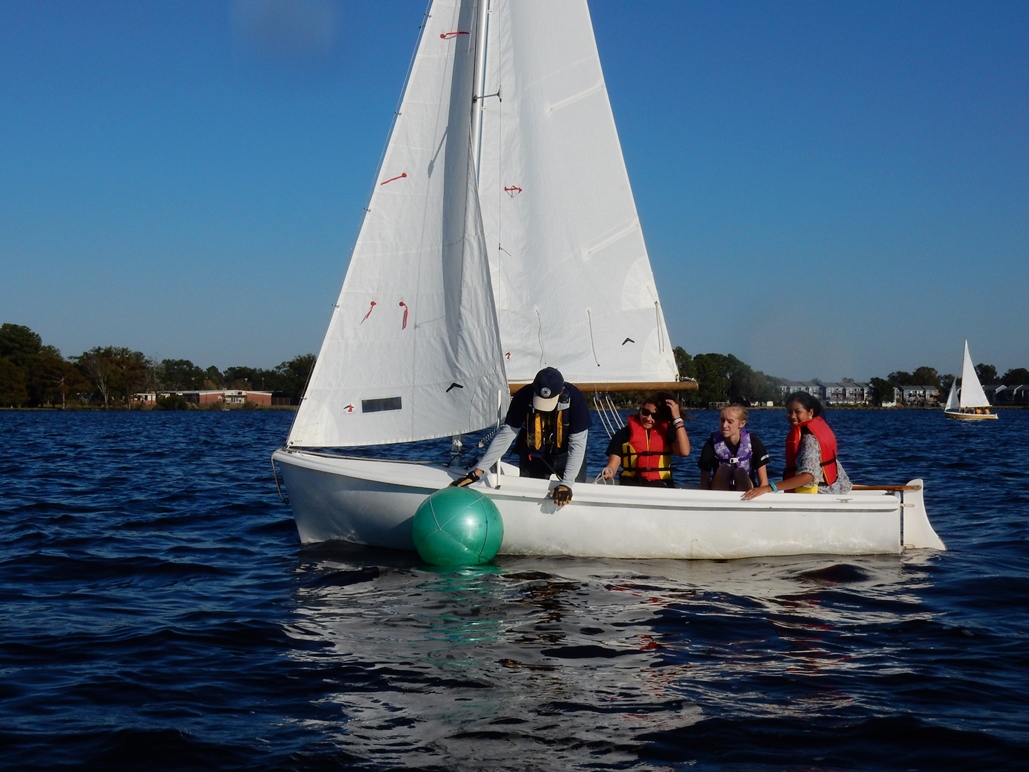
Coach said "Sail right to that buoy" and they did!

Notice the jib is backwinded (deliberately trimmed to the windward side). This helps steady the boat and slow it down. Usually a maneuver we teach advanced cadets, but it comes in handy when getting untangled.


.


OK, let's talk about TACKING.

A TACK is a turn. It can be a turn from port to starboard, or the other way. However, a tack ALWAYS swings the bow towards the wind, then past the wind, so that the sails change sides.

The first step of a tack is to get ready. The lookout must confirm that the path is clear, crew must be ready to handle the sails and to shift their weight (especially when it's windy).

The next step is the actual turn. The skipper will always put the tiller TOWARDs the sail, and hold it there for a brief time.

The crew should release the jib sheet, and start trimming ... slowly... on the new sheet. Why slowly? Because if you backwind the jib (see photo above) it will stop the boat's turn, and the tack will fail. We know this is true, because it happened several times today!

A successful tack is from CLOSE-HAULED to CLOSE-HAULED, Spinning the boat around from a beam reach to a beam reach might work, but is likely to fail because the sails flog for most of the turn. 

What happens if the boat is on a BROAD REACH and the skipper pulls the tiller away from the sail? And keeps turning until the sails change sides? We saw that happen several times today too.


Here is a crew under good control and sailing along . By the end of the day, the cadets had reduced the numbers of mistakes they were making.

Next week, we shall try the Baby Duck Drill (link)!


.

... posted by Coach Douglas King