Wednesday, October 19, 2016

What do we do when there is NO WIND??


.


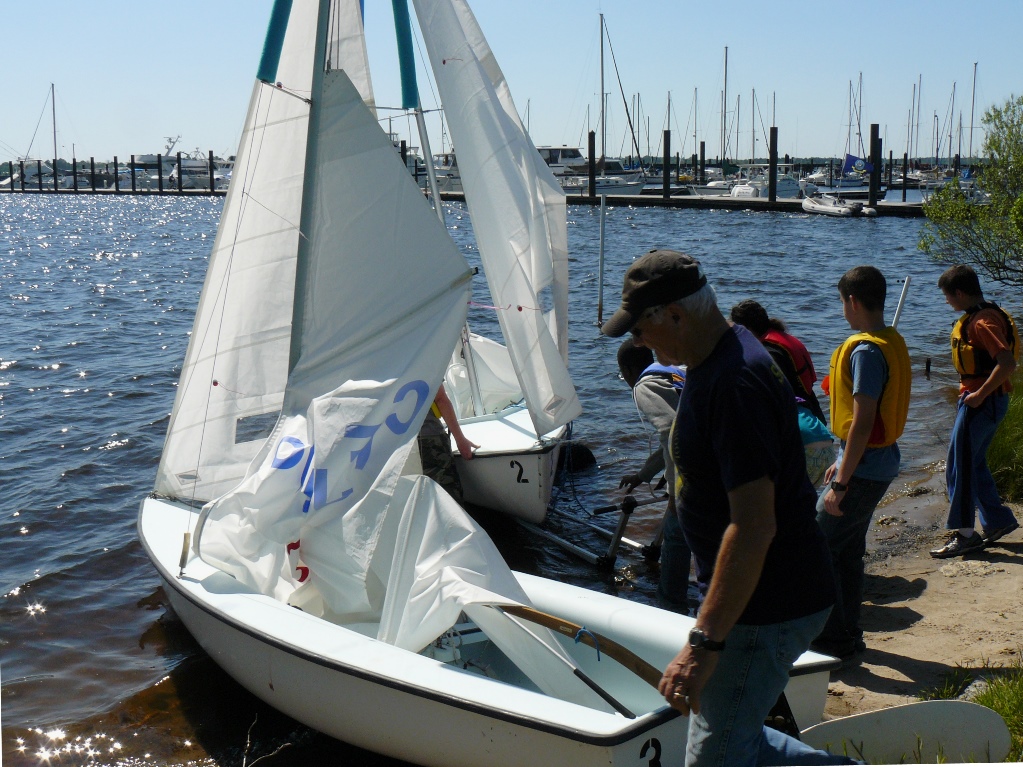
Hurricane Matthew came thru our area a week ago. We were fortunate to have little damage, the boats were unrigged and stored. Now, the coaches have re-rigged the boats.


Beautiful weather, not a breath of wind.


The plan is to launch the Javelins and move them to their regular slips. Not only is there no wind, but the hurricane rains inland have flooded some areas and the river current is MUCH stronger than usual.


The cadets had to paddle against the current. It was a workout but it was also a success.


At this point in the class, we should be beginning sailing drill. Everyone should know the ropes & knots (link). We should be familiar with steering with a tiller, and Points of Sail. Everyone has TACKED (link) several times in our two previous sailing sessions.


Approaching a dock under (arm) power is different than under sail; however some things never change.

It is more difficult to steer a boat moving slowly, yet it is obviously a bad idea to approach the dock too fast. The crew must be prepared with dock lines (in this case, the boat's bow line).


When handling boats around docks, one of the precautions is to NEVER get a body part (particularly hands or feet) get caught between the boat & the dock. Yet we must also take care to not let the boats be damaged against the dock.


There is always more to learn. The class is making good progress, today we also reviewed Points of Sail, Tacking, and Stopping. The whole course is available in our on-line lessons (link). In our next session, we should begin sailing drills and students should be able to sail the boats without coaches assistance. That's what this is all about!


... posted by Assistant Coach Douglas King


.

Wednesday, September 28, 2016

Fall Sailing Sessions Underway

.


We've held 2 class sessions, one at the school and one on the water at Bridgeton Harbor. Last week the sailing class had to be cancelled for bad weather, so we are trying to catch up.


So far, we have studied basic terms, and practiced rigging the boats. To get the sails hoisted properly, we must know standing rigging & running rigging, halyards & sheets, port from starboard, rudder, tiller, and why they call it "the boom." Here's our lesson pages on terminology.

The cadets showed they remembered most of the rigging & terms from 2 weeks ago... not bad, y'all!!


We not only have to remember the details of 'boat words' and which part connects to what rope, we have to keep in mind that we in a different and potentially dangerous world on the water. For example, there is a right way to get on a boat, not doing it the right way can have bad results!


Huh?!? Is there a "right way" to get in a car??!!??!


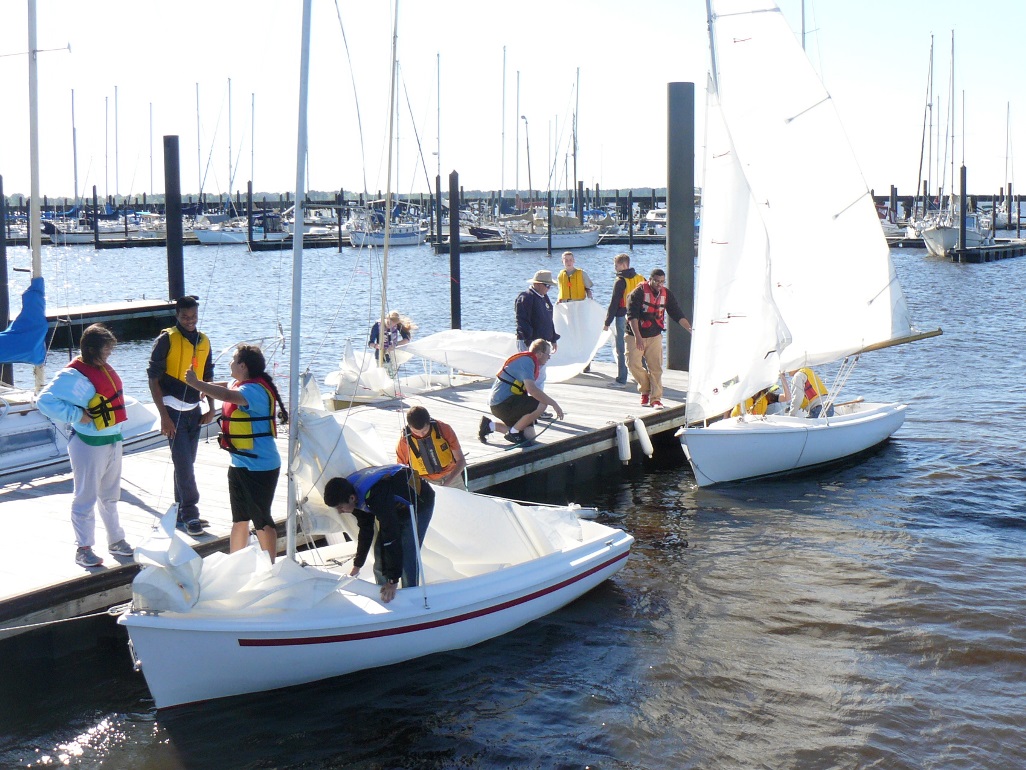
Here you can see the element of TEAMWORK in the cadets rigging their Oday Javelins.

We have a web page lesson on basic rigging


.


Once the sails have been rigged and hoisted, the coaches check everything. Then we get underway! The beginner sailors have coaches with them in the Javelins.

 .


The first sailing session is simple- sail back and forth, getting used to steering with a tiller and handling the sails. One of the keys to making it work is WIND DIRECTION.

Our gold-colored Javelin, with Coach Jackson, in on a nice easy BEAM REACH (point of sail). Is the skipper sitting in the correct position?


.

Docking a sailboat is kind of like landing an airplane. It's not necessarily difficult, but it certainly doesn't happen smoothly all by itself.

.


Under the expert direction of Coach Hittner, this cadet skipper & crew docked their boat almost perfectly, and Head Coach Rezab (in dark blue T-shirt) is on hand to recognize their accomplishment.


Here we see the next crew waiting their turn to get aboard with Coach Hittner.


.

Each crew got approximately 20 minutes of sailing time, this is not much. However we had to switch crews and give every cadet some sailing time. Hopefully, we will get rigged up and underway faster next session, and thus gain more sailing time.

Oh yeah, next time... we will move forward with learning about TACKING (which we did today) and POINTS OF SAIL, with more practice on these maneuvers too. Here's the next web page lesson 

.


Class is almost over- the last part is unrigging and putting all the gear away.

Here we see one of the advanced sailing cadets showing some beginners how to properly roll up a mainsail.

It is important that we keep these boats and the gear SQUARED AWAY. This is safe, it is efficient, and it lets the world know we are capable and serious.


... posted by Coach Douglas King


.


Monday, May 30, 2016

Congratulations to our 2016 SAILORS

.


What does it mean to be a "sailor?" First, it means to NOT be a passenger, just along for the ride. A sailor has a job to do, and must be relied on to do that job correctly even when danger threatens. In the dark, in a storm, water gushing in, whatever: the ship and everyone on board depends on YOU.


Being a sailor means hard work, especially teamwork. The boats must be rigged & lifted onto the dolly, wheeled down to the river, and launched; then held steady while the sails are hoisted. Nobody can do it all, nobody can do it alone.


Being a sailor means having skills and having technical knowledge. It means being alert to surroundings, the weather, the vessels course & location, other vessels nearby. All sailors have to keep a sharp lookout for objects in the water, there may be a hazard like a floating log or there may be a person in the water needing rescue.


We have completed the sailing course for Spring 2016; this was not the biggest class we've ever put on the water -BUT- it is by far the largest sailing class we have graduated as SAILORS. In the past we've had more than 30 cadets sign up for a semester of sailing, but usually more than half the class drops out or does not achieve the qualification. The sea does not accept excuses!


This spring we have 19 cadets who have completed the basic sailing course. They know the ropes (and the knots), terminology, rigging, points of sail, basic maneuvers (including how to stop when you have no brakes), and basic Right-Of-Way rules. They will wear their NJROTC Sea Cruise ribbon proudly!


... posted by Assistant Coach Douglas King


.

Monday, April 18, 2016

FJ sailing... Learning + practice + wind = FUN

.


This is the first time this semester we have sailed the "Flying Juniors," affectionately called FJs. These are the sports cars of our fleet, much lighter, generally faster (not always) but certainly more sensitive and responsive than the Javelins.

Some advanced sailors and a few select beginners rig up the FJs and move them down to the beach. It's a bit more work than rigging up the Javelins at the dock... but oh so much worth it!


I apologize for not having any photos of the beginners sailing Javelins today, but they were working with  Coaches Hittner, Gowans, and Jackson who did not take any pics for me.


.


Head Coach Rezab supervises operations at the beach. It's a clear sunny day, and a "sea breeze" sprang up even as we were preparing to launch. This is why the boats are beached with bows facing outward, it is easier to hoist sails with the boat head-to-wind (or at least close to it).


We had some minor mayhem getting underway with the FJs, mostly because only 2 of the current sailing class have ever sailed FJs anyway, and partly because of the onshore wind (link) . We have not yet learned the lesson about "lee shores" but after today, it should ring some bells.


.


Once we got away from the beach, the sailing part was pretty good. The sailors improved visibly with every tack, every controlled stop, every bear-away. FJ's are very sensitive to sail trim and weight, so the cadet got constant reminders of how to perform better. No capsizes, but a few lose calls!

The sailors in FJ#1 (left, further away) are figuring out what the hiking straps are for. Good fun, and the boat is really moving!


.


We did not get in a good 'Baby Duck' drill (link) . The sailors were just getting familiar with the boats, and tacking, and keeping their weight located where needed (sometimes scrambling!). We did practice TACKING (link) and also STOPPING (link), so these skills will come in handy as we get further into sailing drills.


We are more than half-way thru the semester, and in order to pass, the basic/beginner sailors need to begin sailing drills. The advanced sailors also need practice too (we all do!), but today's session had excellent weather and everybody had a great time!


... posted by Assistant Coach Douglas King


.

Monday, April 11, 2016

Windy & Rough Again... real sailing

.


There seems to be a weather pattern this spring, every Monday afternoon the wind picks up and the river kicks up. After lots of practice on everything we need to do, there is nothing left but to go sailing. So, that's what we do... sail!

But first, we have to rig up the boats. Work before fun! This class is a bit slower than some we've had in the past, many are struggling with the terminology and the parts of the boat. However, we're improving!

Here is the Table of Contents (link) for our sailing lessons. Most of the class would benefit from a little browsing here.


 .


"Which one is the halyard and which one is the sheet?" By now, all sailing cadets should know this basic stuff, we've been studying it for 8 weeks!

To be fair, one of the students in this photo is an advanced sailor helping out, not a struggling beginner.


.


These cadets are all beginners, and they were the quickest to get rigged up. Here they are investing the saved time by practicing a few moves on the boat. Usually the reward for being the first to rig up is MORE SAILING but conditions today were too rough.


.


We also had Coach Mike Murphy (link) bring his own boat, a Montgomery 15 cruiser. Another advanced sailor is showing his ability as skipper, with a beginner as crew. Coach Murphy is on board, just ducked out of sight the moment this photo was taken.


.


We took turns sailing the Javelins, here is Coach Hittner steering while two beginners handle the sheets and get the feel of the boat moving in 15 ~ 18 knot winds.


.


Taking turns sailing Coach Murphy's boat also. These two are both beginners, doing well for their first time.


.


Here we are at the dock, switching out crews. There are several safety rules to keep in mind when handling boats around the dock, and on a windy, choppy day like today, they are not just theory!


.


Coach Murphy's boat has a ballasted keel and is more stable than the Javelins, which in turn are much more stable than the FJs. It takes practice! Here is Coach Hittner correcting the steering of a beginner.

"Don't look at the tiller, look where you're going!" 


.


THIS is more like it!

After all, today was our first actual real-life sail. With such a strong wind and rough water, mistakes could be very costly and/or painful. However, everything went quite smoothly, we only made some small errors and hopefully learned... like this time!


Approx half the photos in this posting were taken by NJROTC cadets

   ... posted by Assistant Coach Douglas King


.

Monday, April 4, 2016

Sailing Today... WINDY & ROUGH !!!

.


We have not had good luck with the weather, so far it has not allowed us to have a real sailing session this semester. Today was forecast to have strong but manageable winds, and as we travelled to Bridgeton Harbor and rigged up the boats, it seemed like we should be 'All Systems Go.' However the wind got stronger and stronger, the waves built up too.

 As 1/2 the class rigged the Javelins, the other half practiced knots. Our 'Basic Ropes & Knots Lesson' (link)


 .


 Our required knots: the 'bowline' (link), the 'stopper' or 'figure-8' (link), the 'cleat hitch' (link), and the 'clove hitch' (link). Knots come easily to some people, or with great difficulty to others, but it's an important skill. Each knots serves a different function and we need them all!

Here we see a successful Cleat Hitch and the satisfaction of doing it correctly. Where on the boat do we use this knot?


.


Anyone could guess that we use the 'Cleat Hitch' to tie the boat to the dock. Yes, true, good... but there is one OTHER important (very important) place we use this knot.

Also, when we are handling the boats at the dock, there are several safety practices you must keep in mind. This cadet is doing well.


.


Looks like a scene of chaos & confusion, but actually this is a GREAT PHOTO because everyone is working at their tasks.   Rigging and unrigging the boats calls for many hands, knowledge of each part of the boats, teamwork, and leadership.

We have had classes of cadets who learned to rig up the boats very quickly and efficiently. Their reward? More sailing time!


.


What's up there? Lots of important stuff! It's never a bad idea to check what's happening with the mast & rigging.


.


Some cadets did go sailing today. A great opportunity, and we all got to see Coach Rezab (our Fearless Leader) demonstrate some great sailing skills.


...posted by Assistant Coach Douglas King


.

Monday, March 7, 2016

SPLASH! ... capsize at the 'Y'

.


Here is how it starts: bringing an FJ to the Twin Rivers YMCA pool.

The coaches get everything ready.


.


Then the class shows up


.


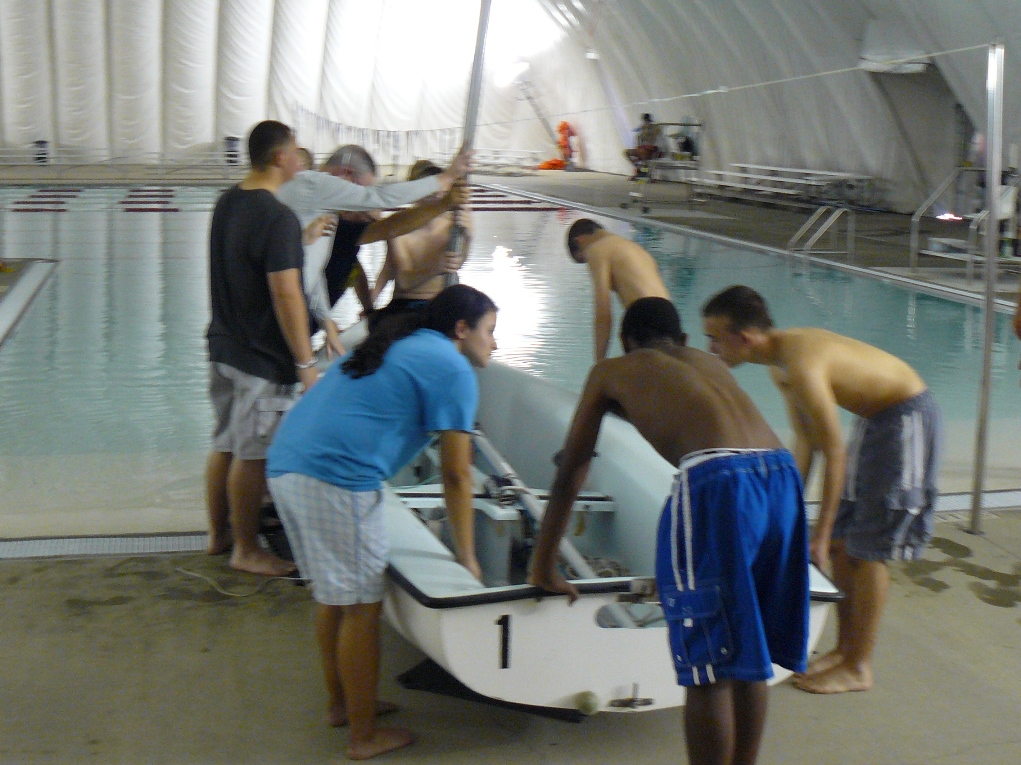
This time of year, the pool is covered by a "bubble" roof.

We have to carry the boat in through a door.


.


To fit in thru the door, the FJ hull is tipped on it's side, and one group of cadets hands it in to another group waiting inside.


.


Now we have to put up the mast & rig the boat. What are the names of all these parts, again?


.


Now we're all ready! Who is going to go first?

We have a few advanced sailors in the class this spring, and they actually run the drill.


.


No wind inside the "bubble" so no sails. However, the skipper & crew (beginner sailors) are in position.

 In the water, an advanced sailor swims the boat into position. Another advanced sailor cadet is on the foredeck ready to pull the boat into a capsize


.


 Into the water!

FJs get very unstable when a person is standing on the foredeck, so this part is easy.


.


You never know how people will react when suddenly dumped into deep water. One big reason to practice is so that if it happens in real life the shock effect will be much less.


.


 Step 1- make sure all persons on board are OK


.


Step 2- get control of the boat

This means one person (usually the skipper) holds the centerboard to ensure the boat does not turn completely over (turtled).


 .


 The crew has a job also, tossing the bow line (painter) over the gunwhale to give the skipper greater leverage, to ensure the sheets are not tangled and the sails free, and to "scoop" into the boat as it comes upright.


 .


 Step 3- the boat is upright, the crew is on board, help the skipper in and sail away!


 .


Everybody in the sailing class got their chance to show they have learned the CAPSIZE DRILL


.


Then, as always, there is work to do. We put everything away properly, being 'squared away' is one of the marks of a real sailor.

In this case, the first step is to drain the water out of the boat!

 Next week, we hope to show what we've learned about rigging and sailing... everybody remember TACKING?  ... but hopefully not capsizing because the river is still cold water.

... posted by Assistant Coach Douglas King


.