Monday, September 23, 2013

Yes, we went sailing today!

.


The NJROTC fleet gets underway! 


Beginners sailed in Javelins with coaches along to help & advise, the advanced sailors rigged up & held practice in FJs. The weather was beautiful and it was a great session as well as big fun.


 Here we see Coach Jackson's newbies learning how to steer, and how to work the sheets... it all requires the ability to see the wind direction!


Is something wrong here? Isn't that front sail supposed to be on the same side as the larger back sail ???
(answer- not always! What Point of Sail are they on?)


.


Coach Rezab's bunch also worked hard at learning skipper & crew tasks. In small vessels, the skipper usually steers... in this case, he is steering quite well and is using the tiller extension properly. Well done!

Meanwhile, one crew keeps the mainsheet and anothe the jib sheet. These must be adjusted according to the wind direction, which determines the Point of Sail


.


Coach Murphy's boat moving along smartly, obviously the sails are adjusted well and the trainee-skipper is holding a good course. Needs to practice using the Hiking Stick though, because in tight maneuvering or in stronger winds the human arm is not long enough to reach as far as the tiller must be pushed/pulled.

The NJROTC sailing program bought new sets of Javelin sails last fall, and these are in great shape. Remember a sail is a working aerodynamic FOIL, not just a big piece of cloth.


.


Meanwhile, over at the beach, the advanced sailors (plus one newby) are rigging up the FJs. They were kinda slow today, must be out of practice.


.


Definitely out of practice... if you look at the big version of this pic, you can see the yarns on the shrouds telling this "advanced skipper" that he is sailing downwind... but he's not listening, the sails are pulled in tight!

However the boat is balanced, helm in good position, they did a good series of tacks & gybes and actually outran the other FJs chasing them, so things weren't all bad.


.


Here we see an advanced sailor.. who often is the skipper but in this case is the crew... completing a "crew task" of coiling & stowing the long ends of the halyards. Lines must be kept untangled and out from under foot. This skipper is also doing a good job steering with the hiking stick... the FJs are tippy and the emphasis is often on HIKING (not quite enough wind today)


Today's lesson was on STEERING and handling the SHEETs, hopefully we learned to recognize the POINTS of SAIL and we practiced TACKING. We should already know all the basic boat parts, terminology, directions, and rigging. We -should- have made a good start on ropes & knots. The sailing students have to move fast to keep up, in order to pass (and earn the ribbon!) you must be able skipper the boat thru basic drills by the end of the semester!

Don't forget we have a written assignment... ... you can refer to the books in LCDR Clark's classroom, or get a copy of our textbook, use our on-line lessons (link), or any other reference.

... posted by Assistant Coach Douglas King


.


Basic Lesson... ROPES & KNOTS

.


1.           ROPE- The basics: You can’t push a rope


Becoming a sailor means “learning the ropes.” This is a general expression for getting to know all the various bits & parts of a complex task; and it holds true here.


  How strong is rope?
 

               Very Strong! Breaking strength of 1/4” line (like FJ halyards) > 1,000 lbs.


               Safe working load can be anywhere from 1/10 to 1/3 of break strength.


                 Tying knots in a rope weaken it by approximately half


Double Braid Rope
       There are different types of rope, & different material used. They have widely different strength & stretch characteristics


IMPORTANT: a ropes “strength” has no relation to its “stretch”


                        Abrasion resistance is very important, a hard edge chafing against the rope can cut thru
                   it within moments.


2.           If you can’t push a rope, what –CAN- you do with it?


a.    Coiling and flaking (also called “faking”)

                    i.      Coiling a rope for storage, coiling for ready use, and coiling for throwing are all different

                  ii.      Stored coils of rope are kept dry & out of the sun


b.        When a rope is IN USE on a boat, it has a specific name.

           i.       generally, ropes on a boat are called “lines” not rope.

         ii.      Be prepared to learn to tie at least 3 kinds of knots

       iii.      During sailing sessions, remember to practice with ropes & lines, in addition to all other skills


c.        Simplest and most important line on any boat: the one holding it to the dock.

           i.      Cadets may use a clove hitch or cleat hitch to hold the boat’s dock line, but until an instructor has checked, you must not leave a boat unattended while it’s afloat.


         ii.         Prevent the boat from hitting against the dock. Fend it off, but do not get any part of your body caught between boat and dock.


Repeat C ii : Do not get any part of your body caught between boat and dock… or between 2 boats


What is this CLEAT thing?

           A “cleat” is just a rope-locking device. There are many types


       Tying the knot: which one for which job?

Remember that tying knots in a rope or line will weaken it!


Bowline Knot- Complete
  Bowline (illustrated)
.... used to make a loop
 .... very secure
.... always easily untied


            note- the “bow” in “bowline” is pronounced just like the “bow” you shoot an arrow with.


 The bowline is one of the most useful knots you will ever learn


Bowline Knot- Step 1

Bowline Knot- Step 2


Bowline Knot- Step 3


To tie a bowline, instructors often say to use your imagination.
Imagine the long part of the rope is a tree. 

 You make a hole in the tree with a slight twist of the rope... now the end of the rope becomes a bunny!

 In Step 3 as illustrated, the bunny goes thru the hole and around the tree. 

Bowline Knot- Step 4


In Step 4  and Step 5, the bunny goes back out thru the hole, and the only remaining work is to pull the "tree" tight and the knot is complete.


Bowline Knot- Step 5


 Figure-8 or stopper knot- keeps a line from running out thru a pulley (block) or a fairlead.

The Figure-8 is commonly tied at the ends of sheets.


            Clove hitch (left)- secures rope around object, will not slide 

 To tie a Clove Hitch- bring the rope around the pole and under itself. Move up a little, then go around & under (thru the middle) again.


                  Cleat Hitch (below)- used for specific lines where cleats are provided, such as halyards & dock lines.


         Why is this important to learn?
Lines & knots can be critical rescue tools

Monday, September 16, 2013

Fall Semester 2013- First day on the water... well a little more wind would be nice

  .
 Today we did not have GREAT sailing weather, but we did have weather so we went anyway.
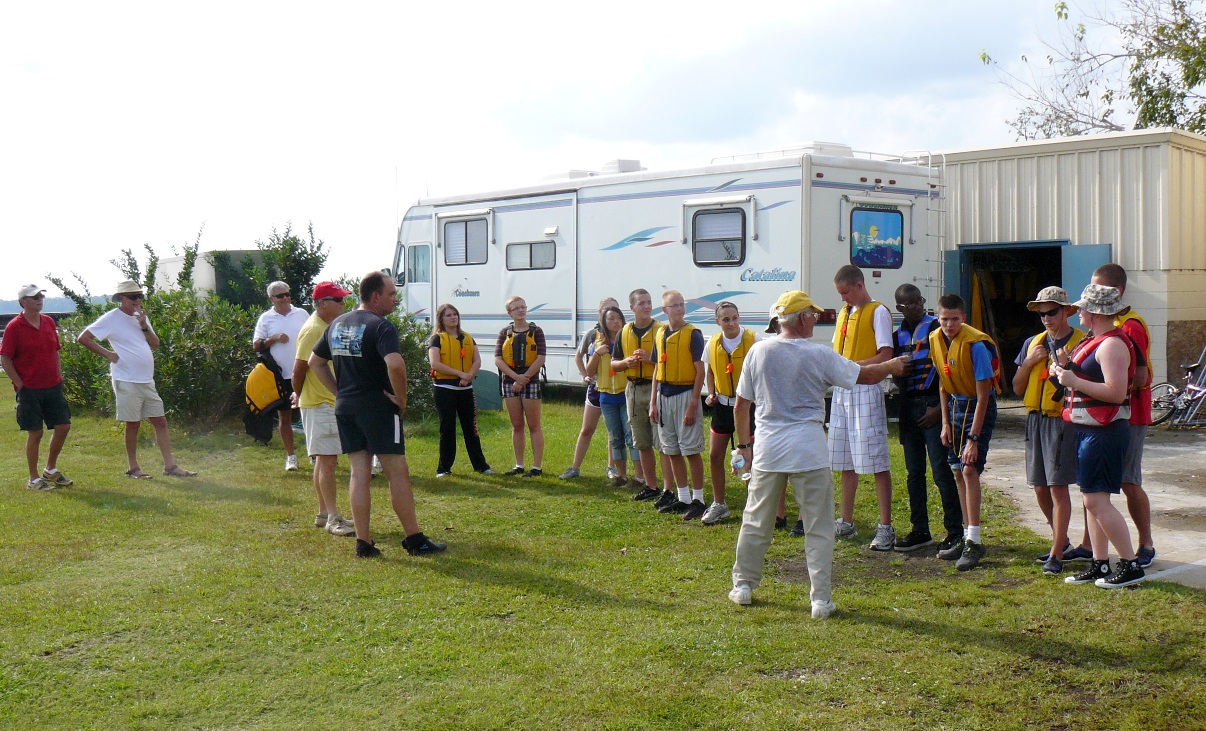
There was little wind, it was cloudy but it didn't actually rain on us...and nobody fell in. This photo shows Coach Rezab dividing up the new  sailors (or hopefully-soon-to-be sailors). Just so you know, this group is a little more than half the size of NB-NJROTC's largest sailing class we've had, but has the potential to be the best sailing class!
.
.

 .

.
.
.
Now everybody has been assigned to a boat, and to a coach, so off we go!.
.
.
.
.
.
.
.

 .
.
.
 .
.
.
.
See! We -did- get on the water. We even hoisted the sails! So who remembers which one is the halyard and which one is the sheet? There is also some othe stuff to remember, and our goal is to be able to rig the boats with no help or advice from our on-water experts Coach Gormley, Coach Jackson, and Coach Murphy.
.
.
.
.
.
.
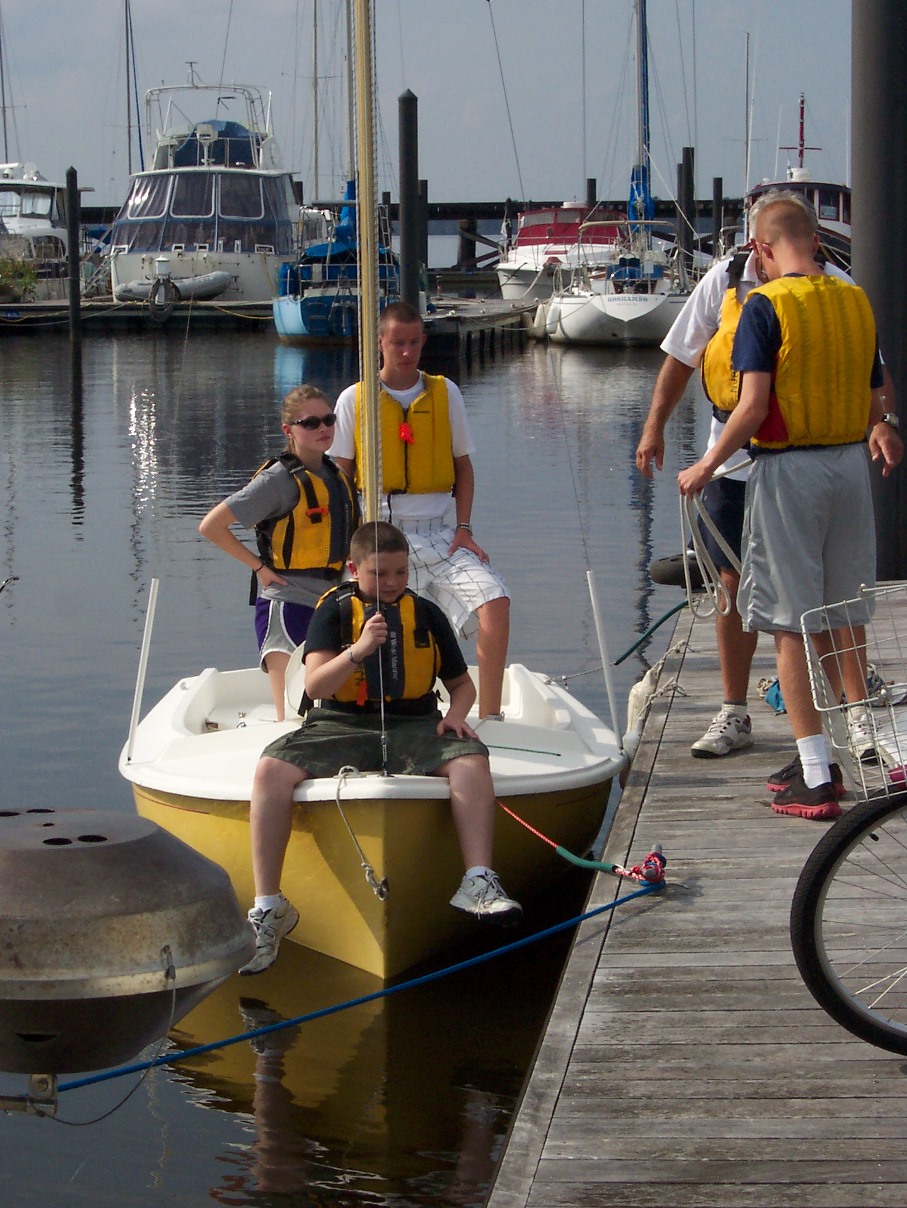
This is Coach Murphy's group in their Javelin. Did we review safety procedures for handling a boat around a dock? Did we learn a little bit about ropes and knots? Did we cover to safely get in or out of a boat? How about the real name for the pointy end?

 .
.
 
 MORE on Ropes & Knots- we sailing coaches decided a while back to not expend sailing time on ropes & knots. This means that you will need to either soak up the required Basic Knots (bowline, figure-eight, clove hitch, cleat hitch) during our sailing time OR learn & practice at school. There are rope & knot practice stations in Top's classroom, and any of the advanced sailors will be glad to show you. As a result, you will get MORE sailing time!
OUR SCHEDULE- so far very few people in this class have attendance above 33%. That is not a big deal for the first three classes, but we have a lot of material to cover and limited time. If you miss a sailing class, you should take the initiative to learn that day's lesson and make sure you practice the skills.
 
Mon, Sep 9... 1500 (3pm) or ASAP after school   already done
Sat, Sep 14... Bridgeton Harbor 1200 already done
Mon, Sep 16... 1500 (3pm) or ASAP after school already done
Sat, Sep 21 ... 0900 (9am) to 1300 (1pm)
Mon, Sep 23... 1500 (3pm) or ASAP after school
Mon, Sep 30...
Mon, Oct 7...
Sat, Oct 12... MUMFest
Sat, Oct 19... 0900 (9am) to 1300 (1pm)
Mon, Oct 21... 1500 (3pm) or ASAP after school
Mon, Oct 28...
Sat, Nov 2... 0900 (9am) to 1300 (1pm)
Mon, Nov 4...
Mon, Nov 28...
... posted by Assisant Coach Douglas King

Monday, September 9, 2013

You can learn a lot in the parking lot

.

Pilots have ground school before they can fly an airplane. We sailor have something similar, especially because pilots don't need to assemble their planes before flying!


We need to learn how to rig the boats before we can sail. Today's lesson for the beginners focused on parts of the boat, how it all goes together, and the terminology.

This photo is the ADVANCED sailors stepping the mast on one of our Javelins. The beginners are all in the classroom at this point.


Yes, you will need to know this! Here is our on-line lesson about BASIC boat parts & terminology. If you missed today's class, you can still get into the Sailing Squad but we only have so many days and a lot of things to learn & do, so work to catch up!


.

 Before you can sail a boat, you need to know how the sails go up & down. Before you can make the sails go up & down, you need to know about the MAST (and of course the BOOM too), about halyards and cleats We start with these very basics to the cadets learn the TEAMWORK of rigging up their own boats. .. .. ... ..... ........ .......... ...... ...... ...... .... .... ...... ...... ...... .......... This photo is our beginners starting with the most basic skill.... how to sit in a boat. Not a joke, there are at least several wrong ways to do it!

.


Here's the engine that makes it go!
.
This coming SATURDAY we will be out at Bridgeton Harbor cleaning the boats & getting them more ready for the fall semester's sailing. Time= 1200 (or noon for those who have not gotten the hang of military time)

Just to be sure, here is the semester's calendar
Mon, Sep 9... 1500 (3pm) or ASAP after school   already done
Sat, Sep 14... Bridgeton Harbor 1200
Mon, Sep 16... 1500 (3pm) or ASAP after school
Sat, Sep 21 ... 0900 (9am) to 1300 (1pm)
Mon, Sep 23... 1500 (3pm) or ASAP after school
Mon, Sep 30...
Mon, Oct 7...
Sat, Oct 12... MUMFest
Sat, Oct 19... 0900 (9am) to 1300 (1pm)
Mon, Oct 21... 1500 (3pm) or ASAP after school
Mon, Oct 28...
Sat, Nov 2... 0900 (9am) to 1300 (1pm)
Mon, Nov 4...
Mon, Nov 28...


... posted by Assistant Coach Douglas King

Thursday, August 29, 2013

Sailing Schedule for Fall 2013... R U ready?

.

Summer vacation can be a beautiful thing... unfortunately it is OVER for this year

Time to crack the whip books and get with the program!

This summer is the first time in several years that we have NOT had a hurricane to help us warm up for the beginning of school.

Here is the schedule for our 2013 Fall Sailing Program
Please note that we have some Saturday sessions scheduled, this will increase the time on the water


Mon, Sep 9... 1500 (3pm) or ASAP after school
Mon, Sep 16...
Sat, Sep 21 ... 0900 (9am) to 1300 (1pm)
Mon, Sep 23... 1500 (3pm) or ASAP after school
Mon, Sep 30...
Mon, Oct 7...
Sat, Oct 19... 0900 (9am) to 1300 (1pm)
Mon, Oct 21... 1500 (3pm) or ASAP after school
Mon, Oct 28...
Sat, Nov 2... 0900 (9am) to 1300 (1pm)
Mon, Nov 4...
Mon, Nov 28...

In order to pass Basic Sailing, cadets will need to demonstrate skippering a boat through selected drills. Sounds easy? OK come show us!

Sunday, July 21, 2013

More Summer Sailing

.


New Bern NJROTC cadet helping to train younger sailors in sloop sailing.


.


These younger kids have already been sailing cat-rigged (one sail) boats and are now learning about bigger, more complex rigs.

The NJROTC sailors begin with sloops, which require teamwork as well as sailing skills.


.


Having turned the "sloop sailors" loose to figure out that pesky jib, the NJROTC cadet now is sailing along with the Opti kids... is he just beating them up (if so, bad news: you're behind them) or offering helpful hints?

.


.


Here is a GOOD version of the "Baby Duck Drill" (link). NJROTC sailors take note!

When sailing as "Baby Ducks" the idea is to keep close together, following the Mama Duck. This demonstrates being in good control of your vessel.


.


More wind, just one lone "Baby Duck." In the choppy water, the girl in the red Opti was having a bit of trouble keeping out of irons, so our helpful sailing cadet led her along on a close reach.

ETYSA (link) offers a sincere THANK YOU to the NJROTC cadets who helped out with our sailing camp!

Monday, June 17, 2013

Summer Vacation... first sailing report


Not only has summer vacation started, but 5 of our cadets have already spent a week sailing!

West Ashley NJROTC in Charleston SC holds a Sail Academy during summer, five of our cadets completed it with flying colors. Since each of the five has already passed our basic sailing program, this is not a surprise.

However, we sail in Flying Junior sloops and Javelins, down there they sail Lasers (aften 2-up although it is designed to singlehand). So it was a different experience!

Here is an exceprt from a cadets' report:
"I just returned today from Sailing Academy in Charleston. It was a great week and had lots of fun sailing those tippy Lasers. Our cadets performed very well in comparison on the water. The wind was great except for just one day, and I have many stories to tell."

No photos (yet) but this post from last year, at the same place & same boats, should give an idea
Link to Bulldog Regatta 2012 

... posted by Assistant Sailing Coach Doug King