Tuesday, March 12, 2013

Underway! ... 1st sailing day spring 2013


.


This afternoon was the first day of real sailing. Most of the class had never been out on the river before, much less under sail, but fortunately the coaches and the "old salt" experienced cadets were there to make it go smoothly. The weather was bit grey but the cold of winter has lost it's grip, there was a nice breeze, and the boats were REALLY SAILING !!


Coach Gormley on the tiller, steering the boat out of Bridgeton Harbor. With new (fall 2012) sails, the Javelins have good power and hustle right along... when the sailors knows how!


The advanced cadets set out in the Flying Juniors, carrying out a variation of the Clock Drill (link) and refreshing their skills. Most have not sailed for a couple of months, even though the sailing clubs on the Neuse River are active thru the winter, our sailing program stands down to give the students time to study for exams.


.

Wind from the SSW makes the river a bit choppy and makes the railroad bridge into a potentially disastrous "lee shore."


Coach Hittner and his crew of newbies just getting out into the river.


If a cadet was sailing this close to the bridge, the coaches would be very unhappy. Coach Hittner sails this Javelin close-hauled and tacks to get the boat a safe distance upwind of the RR bridge.


.


Coach Jackson and two cadets in our third Javelin. The sails are eased out and the boat in on a BEAM REACH point of sail.
.


.


For today's sailing exercise, Coach Murphy brought his own boat. At 15 ft it is only slightly longer than the 14' Javelins, but obviously with a ballasted keel, a cabin, and motor, it is a much bigger boat in other respects.


Now let's see what the advanced cadets are doing. Looks like a gybing duel!

Who has Right-Of-Way here? What maneuver are they doing? How do you get your boat going a little faster, so you can pass the other boat?

By the end of the sailing semester... hopefully before then... the newbies will know these answers, and will be sailing almost this well!


.


 Here's why the FJs are the sports cars of our little fleet. They are faster, can sail very close to the wind, and very responsive.

These cadets are good but not perfect: sit a little further forward in the boat, match the trim of the jib sheets to the main, and HIKE the boat flat.

Looks like a lot of fun!


.


After a bit of coaching, the FJ sailors got in the groove sailing CLOSE-HAULED. Note where sails are: pulled in tight but not too tight. The mainsail in just inside the transom corner, the foot of the jib is on the foredeck.

Although it feels good & exciting to let the boats heel 'way over, it is faster & easier to control when held flat, as you see here. This photo was taken during a lull in the wind, for most of the afternoon these cadets were hiking out.


.


.


Just after a tack... skipper is hiking out, crew is still getting organized... get those sails IN and get going, FJ#1 is getting further ahead!


.


.


.

 Newbies putting their Javelin away after an excellent time sailing.


.


.

.

.


.

The advanced cadets put their FJs away.

You can see that all of this; getting underway, handling the boats skillfully, and putting the boats & all gear away properly; takes a strong team effort.


.


... posted by Assistant Coach Douglas King

Monday, March 4, 2013

First day in the boats... what did we learn?

.

This afternoon the "old salts" put in some work getting their FJs ready to sail; the newbies were introduced to Oday Javelins and continued to learn basic boat stuff.

You Gotta Know The Ropes (link) ... One of the things we learned is HALYARDS pull the sails up/down and SHEETS pull the sails side-to-side.


None of us actually went sailing today, it was planned as a ground-level lesson in the basics. Not only that, but every beginner had the chance to learn & reinforce his/her new knowledge in a calm & safe & controlled environment. It's important to become familiar with the basic actions before throwing the cadets to the lions out into the real river.


Navy sailors will be familiar with the phrase "milling about smartly." Well this mob just got off the bus, a few moments later they were turning to.

Today was a good experience of how much work it is to go sailing. Everybody had to carry sails or spars or gear, everybody had to help rig up the boats.


Every sailing session, every lesson, includes SAFETY. Almost all of our life jackets have whistles attached, today we learned why (and the coaches need to put a whistle on one more PFD). What's another safety lesson we put into practice? Think, you can probably come up with several.


Sailboats are relatively simple, but they do take some work to get ready. And everything has to be put together properly, which means you need to learn how.

Getting ready to put on the sails, but first we need to lower the centerboard and put on the rudder... better pump out the bilgewater too. So we'd better know a little about the HULL and the stuff that goes with it (link).

This is a lot of fun, but it's also a serious class. Today we gave out a written assignment (you could call it a TEST if you like, yes it will count for a grade) and the class is moving forward quickly. In fact, in two sessions we have covered the first 3 basic lessons (our sailing lessons on-line (link)).

Next week, we will get underway for the first time... really sailing!

... posted by Assistant Coach Douglas King


.


.


.

Wednesday, February 20, 2013

Sailing Starts On MONDAY.... We're getting ready... how about you?

.


It's still winter, really... a couple recent blasts of cold have probably not convinced anyone that SAILING is a good idea in the near future, but we are getting ready. Here's a pic of the 5O5 on a recent frosty morning... that white stuff is NOT dandruff!!

The #3 Javelin centerboard has been refinished and reinstalled. Unfortunately we don't have photos of this process, which involved 5 coaches and Bridgeton Harbor's 3-ton trolley lift. Why is this important? Because a FOIL works much better with a smoother surface than big pits of rust!

SCHEDULE... From now on, MONDAYs will be sailing days
Feb 25: NJROTC Sailing
Mar 4: NJROTC Sailing
Mar 11: NJROTC Sailing
Mar 18: NJROTC Sailing
Mar 25: NJROTC Sailing
School Break!
Apr 15: NJROTC Sailing
Apr 22: NJROTC Sailing
Apr 29: NJROTC Sailing
May 4, Saturday: "Open" Regatta at Bridgeton Harbour (link)
May 6: NJROTC Sailing
May 13: NJROTC Sailing
May 20: held open  
June 3: no sailing, get ready for EXAMS and then summer vacation!


.

Sunday, February 17, 2013

Simple Machines... what is a FOIL?


.
(Sailing Lessons Table Of Contents)(link)


We are fortunate that we live in a world of very reliable, very complex machines. We take it for granted that we can travel long distances quickly, talk to people who are far away, have hot food... or a cold drink... when it is convenient to us. Humans started out naked in the woods with nothing but sticks and rocks, now many thousands of years later we have all this, plus the Mars Rover and iPods.


How did we get to this level of technology?


And what does it have to do with SAILING ?!?


Our technology depends on simple machines. The classic SIMPLE MACHINES from ancient times (link) are the lever and the inclined plane...  sometimes the WHEEL & AXLE, the WEDGE, the PULLEY, and the SCREW are included but these are all special applications of the lever and the inclined plane or a combination of the two.


Although ROPE is not classified as a simple machine, it is certainly very useful. Here we have an assembly of wheels, along with some specially-shaped wedges, that enable us to control large amounts of force on a vessel's sail.


Ancient peoples had the technology of sails; is this a simple machine?

In a way, it is. A sail is a FOIL which is very much like an inclined plane (or wedge) used in air, or water, or any other FLUID (yes air is considered a fluid) (link). Other FOILs include wings, impellors, and turbine blades; foils are used in many types of complex machines.


The word "foil" can mean several things, from a type of light weight sword to very very thin metal used for wrapping up food. These things are useful too but they will not make a boat sail!


A "FOIL" is a simple machine... look Ma, no moving parts... which uses the energy in a moving fluid to generate power.


When we sail, we use two sets of FOILs. One set is the sails using the air to propel the boat, the other set is less obvious: the centerboard and rudder which control the the boat's direction. Both sets of foils are critical to sailing, and we are lucky to have centuries of development in making better foils which make sailing easier & more efficient.

Fluid... air, water, oil, nitrogen, whatever... has MASS (link). This is a scientific way of saying it weighs more than nothing, although weight is not quite the same as mass.


So, the movement of fluid implies energy, and that energy means a fluid will always exert force on any object in it's way.


Just because the movement of fluid generates force, this does not necessarily mean that we can gain useful work from that force.

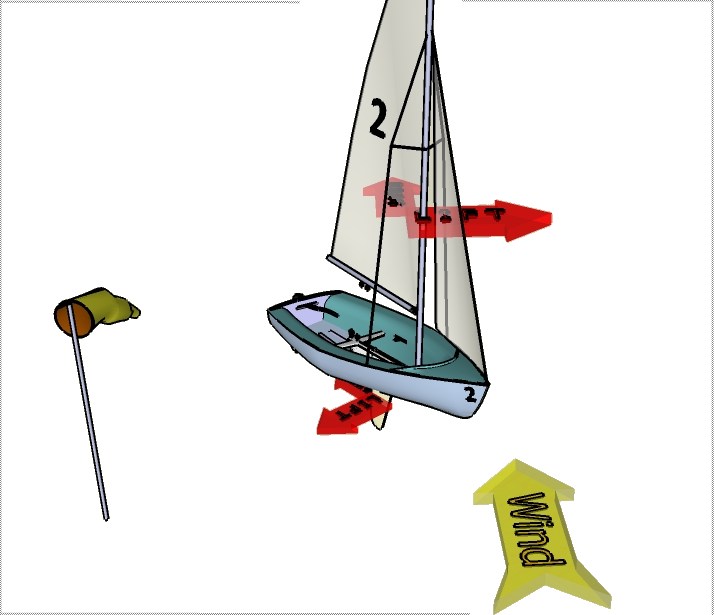
It may help to think of the FORCE in these diagrams as rubber band, stretched, pulling in the direction of the arrow. The bigger the arrow, the harder it is stretched.


IMPORTANT CONCEPTS:

The energy present in a fluid in motion will always exert some force on an object. "Drag" may be considered as similar to friction.

"Lift" is always at right angles to the direction of fluid's movement.

"Drag" is always in the same direction as the fluid's movement.


Can "Lift" be downward? Sure, why not? Lift will be exerted in whatever direction the foil is oriented, it is up to us to decide how to use that force. When we are sailing, the force of LIFT is exerted horizontally by the sails and the centerboard & rudder.


Generally we think of "lift" as being upward, away from the ground, but when we use "lift" as a science or engineering term, it has a specific meaning that has no relation to up or down.


Review... when fluid is moving past an object, or an object is moving through a fluid, we will always have some force being exerted. We will always have drag, but we might or might not have LIFT.

The shape of that object makes a big difference. A FOIL can have many shapes, some are better than others. By "better" we mean generating more lift and less drag!


However, even a flat plate can work as a foil.


What kinds of foil work best? Like any type of machine with many many variations, the desired function has to determine what kind works best. Wind turbines will use foils that look different from steam turbines which look different from airplane wings. An airplane intended to fly slowly, or specialized to take off & land on short runways, will have very different wings than planes designed to fly high or fast.

A spinnaker, which is a sail used for going down wind (broad reaching or running), looks very different from a genoa jib, which is a sail used to primarily to go upwind (close-hauled).


.


Let's take a quick look at how to define or describe the shape of a foil:


The Spitfire was the best fighter plane of it's time, largely due to the performance it's wing. This is a nice picture and gives you a good idea what the Spitfire looked like, but it doesn't really show important details of the wing.


The CROSS-SECTION (link) (often simply called the "section" or "foil section") is what you would see if you cut the wing smoothly across the same direction as fluid flows over it. This is how the fluid "sees" the foil and this is the most important characteristic of the foil's shape.

It is easy to guess that a thick wing is for flying slow, and thin wing is for flying fast, and generally this is true. However as we will see, flying is not that easy (link to STALL) and foil behavior is not that simple! (link to Supersonic Foil wikipedia)


.


When we say "thick" or "thin" foils, we don't mean a simple measurement in feet or meters (link to wikipedia). Obviously, making the whole foil section bigger will make it more thick, in the normal meaning of the word. However, the top two foil sections in the diagram are identical, the second (middle) foil is NOT thicker. The third (bottom) foil is thicker.

"Thickness" is relative to the size of the foil... specifically, the length of it's cross-section.


When sailing (or carrying out any other complex process) we must be as exact & precise as possible when communicating. This means using correct terminology, whether it is a matter of Right-Of-Way or foil geometry (link to NASA) ... One advantage we sailors have over other people using FOIL technology is that we can change the shape of our foil(s) relatively easily, using the vessel's rigging. This will be covered in more detail later.


What else is important about how a FOIL works? Lots of diagrams show the foil is at an angle to fluid flow, and obviously this angle can be changed. We sailors use the SHEETs to change the angle, a pilot must change the angle of the whole airplane.


.


Here we see three boats, the 3 skippers have different ideas about how to trim their sails even though they are all on the POINT OF SAIL (in the diagram, a close reach on port tack). .     .     .     .     .     .     .     .     .     .     .     .     .     .     .     .     .     .     .     .     .     .     .     .     .     .     .     .     .     .     .     .     .     .     .     .     .     .     .     .     .     .     .     .     .     .     .     .     .     .     .     .     .     .     .     .     .     .     .     .     .     .     .     .     .     .     .     .     . The first boat has their sheet eased out and the sail has an ANGLE OF ATTACK of 15 degrees, although this is not any data that you would have (or could use) while actually sailing.     .     .     .     .     .     .     .     .     .     . .     .     .     .     .     .     .     .     .     .     .     .     .     .     .     .     .     .     .     .     .     .     .     .     .     .     .     .     .     .     .     .     .     .     .     .     .     .     .     .     .     .     .     .     .     .     .     .     .     .     .     .     .     .     .     .     .     .     .     .     .     .     .     .     .     .     .     .     .The second boat has pulled their sheets in so the sails are tighter, to an ANGLE OF ATTACK of 25 degrees. .     .     .     .     .     .     .     .     .     .     .     .     .     .     .     .     .     .     .     .     .     .     .     .     .     .     .     .     .     .     .     .     .     .     .     .     .     .     .     .     .     .     .     .     .     .     .     .     .     .     .     .     .     .     .     .     .     .     .     .     .     .     .     .     .     .     .     .     .  The 3rd boat has pulled their sheets in even more, so the sail is pulled in tight to an angle of 35 degrees. The sail is set in a position approaching what would work if they were CLOSE-HAULED. As you can see by the air flow swirling (turbulence) around the sail, this is not an efficient way to trim the sails! 

Both LIFT and DRAG will change as the ANGLE OF ATTACK changes. For any given FOIL SECTION and a given fluid flow past it, there will be one ANGLE OF ATTACK which gives the greatest amount of LIFT, and one specific angle which may not provide maximum lift but will provide the most efficient ratio between LIFT and DRAG. The section shape will affect how large of an angle will be effective, and whether the balance between lift and drag changes smoothly or dramatically, and whether the foil will be prone to stalling. 
You can see this is a complex subject and we will clarify some of these concepts later. More specifically, we will show how to apply the relationships between angle, flow, camber, lift, and drag, in order to sail better!

For now, let's review-

- moving fluid exerts FORCE on objects in it's path

- the force of LIFT is always considered as perpendicular to flow, DRAG is in the same direction

- the ANGLE OF ATTACK is very important to making a foil work efficiently. 

- the SECTION is one of the most important ways to define/describe the shape of a foil.

- THICKNESS of the FOIL SECTION is relative to the length of it's CHORD, not a measurement in inches or centimeters


.
.


There is a great deal more to study on this topic: pressure and flow relationships, how the angle and shape of the foil affect it's performance, and specifically how all these things relate to sailboats and other vessels. For example, a ship's propellor has blades which function as foils. We will soon have a 2nd lesson available on FOILs to go into more detail.


For now, we will show a diagram of an FJ sailing, with the forces of lift and drag shown on the sails and the centerboard.
F.F


(Sailing Lessons Table Of Contents)(link)
.

Friday, January 11, 2013

Welcome to 2013... lots of work!

.

It's a New Year!

We have two new fully-qualified Skippers who completed their Blue Books and are now proudly wearing their aiguillettes. These were awarded by LCDR Craig Tyson at his retirement ceremony... that's right we also have a new Commanding Officer.


The coaches have been keeping busy on the boats. This pic is not a capsize drill, it's cleaning & inspecting the hull. Fortunately winter has been mild and Head Coach Rezab has been able to remove a rusty centerboard which needs attention.


.


How do you remove a rusty centerboard? Very carefully! Let's just say that it is more work than we expect from the cadets... at this time...

Coach Rezab had the capable help of Coach O'Flanagan putting the boat on a crane and accessing the pivot bolt to remove the centerboard. Javelin 'boards are ballasted which increases the stability (link), but like most sea creatures they are heavy and awkward on land.


How rusty was it?
Extremely!

Here is a close-up view of the centerboard after -some- of the rust had been laboriously removed.

A better and complete job was done by sandblasting


.


Because humidity in the air causes rust to begin forming instantly, it was important to paint on a protective coat of primer  ASAP... in this case, with about 20 minutes.

Next, the centerboard will get smoothed-over with a thick layer of epoxy. Hopefully the coaches will be able to give it a bit more of a FOIL shape instead of a pitted flat plate.

Monday, December 24, 2012

How to GO in a sailboat that doesn't want to

.


First of all, it's is so easy to make a sailboat MOVE that you can't -not- do it. The dadgum boats are always moving... rocking, tipping, sliding sideways, drifting downwind, or drifting with the current (or some combination of all the above).

The question is, how do you make a sailboat move in the direction you want it to?

This can seem easy when everything is going right, and impossible when things won't go right. That's where knowledge and skill come into the equation... a good sailor will get their boat going right when it seems every factor is against them.


The best thing to do as a beginner: memorize this diagram. We're not kidding!


A sailboat will make progress... or not... according to the Point of Sail which it's on. This is determined by the direction of the wind relative to the direction the boat is headed. As you can see in the diagram, the closer the boat is angled to the wind, the tighter the sails are pulled in.


.


Here is a beginner sailor that needs some help figuring this out. He is stuck "in irons" and the boat will not move forward.

Unfortunately the coach is taking a nap.


.
 

These sailors have it figured out... it doesn't hurt that the coach is actually coaching, too!

The first key is to STEER the boat at a consistent angle to the wind. In this diagram, approximately a "beam reach" as determined by the coach who is flying the L flag ("Lima" means 'come here' or in this case 'follow me').

In this diagram, you can see the little red yarn on each boat's standing rigging which helps give the skipper a clue about wind direction, and thus which way to steer.

What should the first boat in line do? (hint- something involving the "MAIN SHEET")


.


Here are two boats that need help. They have it almost figured out, at least they are not trying to steer straight into the wind. If they pulled their sails in -really- tight, they may be able to get moving.

What would happen if they pulled their JIBs in really extra-tight for a few moments?


 Some people have a natural feel for being able to make a boat sail properly. For most, the first few times sailing are frustrating. These lessons attempt to put forth the basic skills needed to get a boat moving under sail, and to keep it under your command. You will need to know the beginner terminology (link) before you can get underway and try to make it work.


What makes sailing difficult? First of all if it were easy, it would not be as much fun!

One factor which makes it difficult is that thing we mentioned at the beginning... boats are NEVER sitting still. Here we see two boats which are not sailing, not moving forward, but they are being pushed sideways by the wind. They are pointed in the direction of a BEAM REACH but the sails are not driving the boats forward. With no water flowing past the centerboard & rudder, the boats cannot be steered.

It does not matter which way you put the tiller if the boat is not moving forward! Furthermore, once the boat -IS- moving properly, holding the tiller straight does not guarantee that the boat will move straight forward. When we first get underway, we will try to make it easy for the beginners by playing "Baby Ducks" (link). The Baby Duck Drill is also fun for advanced sailors.
 
.


.
 These beginners are getting it right... steering a constant angle to the wind (in this case, a BEAM REACH on STARBOARD TACK).

As long as the sails are making the boat move, we won't worry about whether to pull them in or let them out for precise aerodynamic efficiency

However, we will say two things about sail trim because steering is easy and it will be very soon that you will have to think and take action with the sails & sheets.

1- Basic rules to go by:  flappy is not happy
.......................................when in doubt let it out

2- the boat with the most precise sail trim will go the fastest (assuming the steering is correct)


.

.

Sunday, December 23, 2012

Merry Christmas !!


.


At this time we'd like to remember the generous gifts which have made this program possible


Bridgeton Harbor continues to give us a "home base" in one of the best sailing venues around.

Head  Sailing Coach Jerry Rezab continues to give large amounts of his time & dedication.

Brett M gave us an inflatable chase boat (great for practicing soft landings)

Dan B gave us the hot-rod 5O5.

West Marine has given us vital safety gear.

In fact all of our boats were acquired thru donation, we could not do this without the spirit of generosity. We hope that all of you, cadets & coaches & benefactors, are having a great Christmas.

And a special holiday wish for peace and joy to all our brothers & sisters who are currently serving our country.

... posted by Assistant Sailing Coach Douglas King

.