Sunday, July 10, 2011

We test-drive... err, test-sail a new boat!

.

Thanks to Dave Ellis, owner of a new Raider II Turbo sailboat, we had a chance to sail around in a new type of boat. Not just new to us, but relatively new to the sailing world.


Here are Cadets Ferree & Taylor showing how easy it is to go fast in this boat


This is a 16' sloop with a innovative hull design. It is very ergonomic and efficient. It is easy (in fact it's downright comfortable) for the skipper & crew to place their weight far outboard for increased righting moment... in other words, you can hike out farther & harder, with less work... and that means more horsepower coming from the sails. The "wings" on the sides of the hull are also very buoyant, and increase the reserve stability such that the boat is very difficult to capsize.

The sails are also designed to produce more power. Of course, this means BIGGER sails, but they also have full battens at the top (this is not really a new idea, but in this boat it is very well implemented) for a more efficient aspect ratio, and complete adjustments for shape.


The Raider jib is set on a roller-furler, so the boat can be sailed easily with just the mainsail or as a sloop.

Here we see Coach King advising the test pilots on how to unfurl the jib, and then furl it back up again if desired. The jib is a great way to keep the crew busy!


.


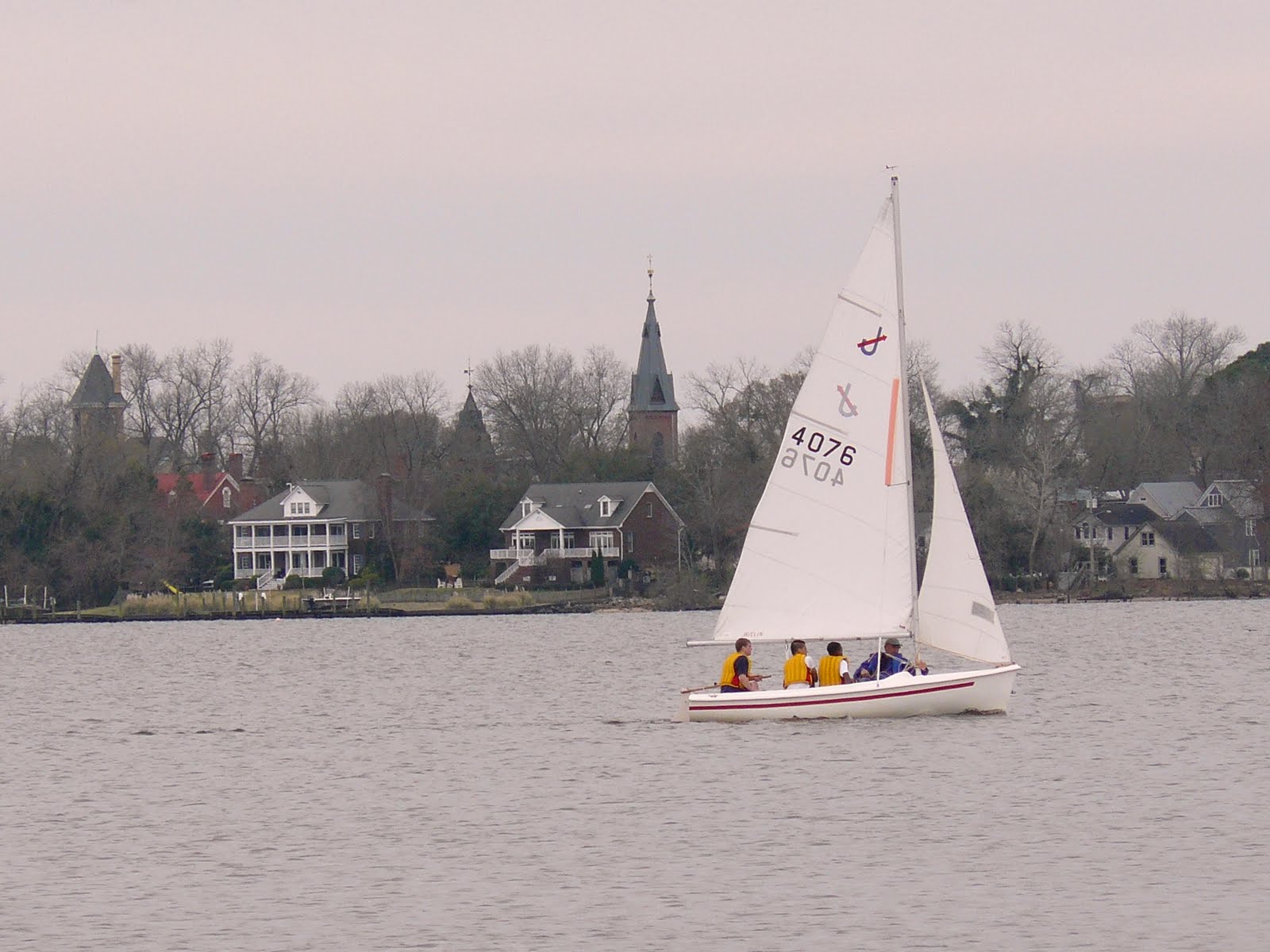
Blackbeard Sailing Club in the background, the Raider zooming along close-hauled... dealing easily with the motorboat wake... and in the foreground, Cadet Taylor practicing his boat-handling skills.


.


Looking down to make sure that feet are under hiking straps... okay guys now hike the boat flat!

.

One of the advantages of the Raider is the double hull allowing the cockpit to be completely self-bailing.


.


A brief rest on the beach before putting the boat away.


... posted by Assistant Coach Douglas King

Saturday, July 9, 2011

End of the School Year... Forward Into Summer

We tend to look just at our own little corner of the NJROTC world... yeah it's Navy but that doesn't mean it's all about boats! The New Bern NJROTC has a very full plate, and continues it's strong academic record. At the end of spring, we have college plans & summer jobs. We say goodbye to the graduates. We have an annual banquet to gather with families & celebrate.

Our spring semester sailing cadets who stuck with the program, turned in written assignments, worked at "learning the ropes" (and the knots), get the honor of standing in front of the brigade to be recognized as SAILORS.

What does it mean to be a sailor? First, it means having skills & technical knowledge. Our little sailboats are simple but each part has a special name and it must be rigged correctly to work. Being a sailor means to be alert to one's surroundings. Awareness of the weather, of the wind direction, and keeping a lookout for objects... OR PERSONS... in the water, is necessary at all times.

Being a sailor means being a reliable part of the team. You must do your job even if the wind is gusting and the boat is heeling 'way over about to capsize. You must concentrate & do your job because the vessel and everyone onboard is depending on you. Being a sailor means to be resourceful and self-reliant. You can't get out and walk home! You can give up & quit, but you're still out at sea.

These are all characteristics we'd like to see in ourselves, in our family, in our co-workers, and very definitely in the next generation coming along. This is what it means to be a real sailor, and this is what our sailing program is all about.

At the banquet, we also give awards. The highest award we can give in the sailing program is the Skipper's Aiguillette. This requires learning not just how to sail a small boat, but demonstrating leadership in a wide range of on-water activities. It requires learning to navigate, to read weather systems, learning about different types of vessels, the physics of buoyancy & stability, communication inculing radio protocol... it's a big step.

Cadets Wheeler & Fouts are awarded their Skipper's Auguillettes.


Another event that occured at the end of the spring semester is a change of command. The New Bern NJROTC Brigade had it's change of command, and the Sailing Squad also has a new cadet commander. Congratulations to the Brigade officers and to Andrew Ferree on becoming "Top Sailor."

I apologize for the long delay in getting this post & pics onto the web site. Hope everybody is on their way to having a GREAT summer. We will have more sailing news soon!

...posted by Assistant Coach Doug King

Thursday, May 19, 2011

Docking Lesson 1... stopping would be nice

.

Learning how to GO is obviously one of the first steps, but when you think about it, learning to STOP is just as important. Maybe more so.

.

Here's a boat sailing along on a beam reach. The skipper turns slightly away from the wind, and eases sails out as far as they'll go.


Is the boat going to stop? After all the jib is just flapping and the mainsail is at least partly flapping. Very little if any forward power is being produced.


The answer- this boat will slow down but it will not stop. Even the flapping sails exert a force called DRAG (link), and when the boat is angled downwind then it will be pulled forward.


Here is a boat that turns directly head to wind. This boat will definitely come to a stop and may begin sailing backwards. It is difficult to judge how how far the boat will coast straight into the wind. What's more, it will be difficult for the crew & skipper to see what's in front of the boat and it will also be difficult to get the boat started moving again.

Is there a better way to STOP?


.


If the boat turns a little into the wind and the sails eased all the way, the boat will stop. The sails aren't flapping right in their faces so they can see & still balance; plus it's easy to get going again by just pulling in the sheets a little.

This is the better way to STOP a sailboat


.
The STOP drill- step1. tiller toward the sail... T-T-T... just like tacking, but DO NOT tack! (link to "TACKING")
step 2. ease the sails.
step 3. repeat steps 1 and 2 UNTIL the sails are fully luffing (flapping) freely
step 4. pull the tiller to center sharply, if the boat is head-to-wind in irons, or almost so, put the tiller AWAY from the sail (or where the sails used to be) to put the boat at an angle to the wind, before it completely stops and you can no longer steer at all.
.


With a little practice, a beginning skipper should be able to bring his boat to a stop right beside one of the buoys. This is safer than practicing on a real dock.


We will practice docking in all conditions, so be prepared for a coach to ask you to demonstrate.


In order to fly a plane, you must learn to bring it in for a landing. Same with a sailboat, maybe a little easier learning to dock BUT it's still necessary. And it's worth practice even for experienced sailors.

There's no such thing as being 'too good' at docking!

(link to GLOSSARY)


.


.

Saturday, May 14, 2011

2nd Annual Regatta... is it a tradition yet?!?

.

Here is the scene, getting ready for our 2nd Annual Regatta. It was a big success!


Our program is really oriented towards developing teamwork, leadership, and seamanship BUT the races are a challenge of skill and good clean fun too. The regatta is a fundraiser (boats, sails, and gear are ex$pen$ive) and also raises awareness in the community.


.


R-r-r-racing!


Here's one of the high school teams versus local hotshot (in 2nd childhood). In this situation, boat #6 is vulnerable to be passed at the next turning buoy but for now have the advantage of Right-Of-Way (starboard tack).


.


One of the great things about our sailing base is that we have FRONT ROW SEATS for the action. Most places where sailing races are held, it is very difficult for anyone to watch unless they get in a boat themselves.


.


Here are some of the racers on their way upwind. The boats are 'close-hauled' with the sheets pulled in tight, and the skippers choose their route on a zig-zag course toward the Neuse River highway bridge in the background. The other three boats skippers thought the other tack was faster (these boats are on Port Tack) so the fleet is split up.


.


Here's the part of the race where the fleet is going directly down wind. All are running 'wing & wing' with the jib opposite the mainsail.

It can be very close, and the sailors must know the Right-Of-Way rules in order to not have problems & collisions. This was close racing, it was exciting even if the top speeds are not high.


.


In last years regatta, we did not have a New Bern NJROTC team entered. This year, a couple of our most experienced cadets (both have sailed big keelboats in the NYRA Winter Series) took up the challenge! They did not win, but they did prove that they could sail the boat efficiently and knew the Right-Of-Way rules... at one point they almost passed Coach King, but he still has a few tricks he has not yet taught them...


.


Here's Coach Murphy and the Commander sailing in our #1 Javelin. It would not be a fair match to race these against the Flying Juniors, but it must have been tempting to try!

By the way, several of our basic sailor cadets skippered the Javelin during the day, taking the opportunity for some practice while they were busy with regatta work.


.


Once the skippers get the hang of the time signals, and getting the boat into the right spot with all systems "GO", this is what the starting line looks like. Remember there are 3 more boats jammed in close behind these 3.

Don't our new sails look great, too?


.


Here's a look at the starting line and our Race Committee vessel, COMPASS ROSE. Nice view of historic New Bern in the background. Several cadets served on the Race Committee, signaling the sailors, communicating with shore & with the chase boats, and recording the finishes. After a semester of our training, they know their way around a big boat too!


.


Here is a crew's-eye view of DOCKING A SAILBOAT. We don't have brakes, so bringing the boat to a full stop requires some skill & maneuvering. Then there are all the other boats in the way, and of course the potential to capsize right at the dock (not the recommended method).

The helpers are ready, we had no crashes and no capsizes. It's really a lot more fun that the photos can possibly show you!


.


Here's our Head Sailing Coach Jerry Rezab and his 'crash boat' crew. Their job is to stand by for rescue, to tow the sailboats if needed, to ferry Race Committee crew out to the RC vessel, and they also placed a warning buoy at a large obstruction (a piece of some derelict building) in the river.

The 'Blue Book' sailors are allowed to drive the program's motor boats once they are qualified, but this comes only after passing the basic sailing qualification.


.


Last word-
Congratulations and BRAVO ZULU (that's Navy-ese for "Great Job, Well Done!") to the winners of our 2011 Regatta.

Y'all come back, now!


... posted by Assistant Coach Douglas King

Thursday, May 12, 2011

Spring Update... yes we are! (sailing, that is)

Apologies for the lack of photos of our sailing progress. We have had 2 successful sailing days in the FJs and the Javelins. So far, no newbie skippers have passed the basic drills but we are building knowledge & skills, we're getting there.


We had a cadet go overboard into the Neuse River but the coaches were at hand; the whole episode from accidental gybe + falling overboard to being pulled into the RIB safety boat took less than a minute. BTW the weather is warming up but the water is chilly!


Our experienced sailors are in the FJs getting some practice in all the maneuvers from gybing to docking; we still don't have a racing team BUT we do have some skippers who recently passed their Navigation qualification.


.


In other news, the New Bern NJROTC's fleet was reduced by 1 boat- we had a Pintail donated years ago and Coach Rezab sold it after a full reconditioning. This was our dry-land exercise boat for a few years but we have little use for it as a sailing trainer. The money received will help pay for ongoing operations like bus transport.

Generally, we do not solicit donations of boats to resell but only accept boats we can use in training. We would love to get some more Flying Juniors and maybe one or 2 more Javelins; we could also use a 2nd safety boat (and motor & trailer). Gear is also welcome, in particular we need new lifejackets!


... posted by Assistant Coach Douglas King

Thursday, March 31, 2011

Practice, Practice, Practice... ... ( 21 Mar 2011 )

.


The weather has not cooperated with our sailing plans. Instead of getting underway in the FJs, we held practice at the dock in the Javelins.


Here's a photo from the Bridgeton Harbor launch area, showing why we were not putting the FJs in. Strong winds, ~2'+ choppy waves, lee shore... let us count the ways in which this is a bad idea... ...


.


Here's how we held practice in the Javelins. With a line from each side at the stern of the boat, we can hold the boat at an angle to the wind, or swing it around as though the skipper & crew were maneuvering under way. This is a good "sailing simulator!"


.


Each new skipper & crew practiced tacking, and setting the sails correctly for most Points Of Sail. The wind was very gusty, some of us got a chance to practice easing the sheet when the boat heels too much!


.


.


.

Here's our #1 Javelin (the USS Craig-Bob) with cadets manning the helm & sails. Coach Murphy is directing the same drill in Javelin #2 (as yet un-named, who will earn the right to name it?).

First we practiced rigging the boat, then hoisted the jib. The skipper is steering properly, with the hiking stick & sitting amidships (actually he would do better to sit a bit further forward). The crew is balancing the boat & holding the jib sheet. In fact, she is holding -both- jib sheets, in readiness to TACK. These cadets did very well practicing tacking, using proper commands & communication.


.


.

"Which way does the boat turn if I move the tiller -this- way"

Coach King (holding bow line, wearing hat) turns the boat just as it would if sailing free; although not with such potentially bad consequences. Let's get those mistakes done & over with now!


Congrats to all the sailing cadets who completed their qual on KNOTS this week... we are better prepared than ever, and our next sailing session will be a success!

... posted by Assistant Coach Doug King

Tuesday, March 8, 2011

1st sail, 2011... dude where's my mast

.


This afternoon, after battling Hwy 70 traffic on land, the New Bern NJROTC sailors got underway. The coaches had the boats already launched, to save time (don't get too accustomed to this) and we only had about 45 minutes of sailing time on the river. However, in that short time frame, every sailing cadet had the chance to take the helm.... everybody learned a bit more about all those ropes & stuff too.

(Our Javelin #2 w Coach Hittner, nice background of New Bern landmarks)


This is the first time both Javelins hit the water together. These boats are a little bigger (less than a foot longer) than the FJs but much beamier & heavier. 3 cadets and a coach filled up these boats, but they move right along & really sail... until the mast falls down, anyway! Javelin #2 had a side-stay pin fall out, splashing the whole rig in the water. No major damage though, and at least it waited until the end of the day!


We put 5 of our Flying Juniors in the water, 2 with qualified cadet skippers from previous semesters, and 3 with coaches skippering... although the cadets got a chance to swap places and take the helm themselves!


Could we use a little more wind?


.


Here's Javelin #1, the "USS Craig-Bob," with Coach Murphy and cadets getting the jib sheets right.
.


FJ #2 with a cadet at the helm... holding a good course, sails set correctly for their point of sail... still, there's something wrong with this picture... umm, wait, I know! They are too close to the railroad bridge!! Does anybody remember any of the coaches saying something about that? Weren't there some buoys or something out there??!?


.


Here's our two qualified cadet skippers, looking pretty good. You can see from the bow wave that the FJs move right along even in relatively light winds. They'd go even better if the crews eased the jibs to match the mainsails (hint). The two Javelins are in the background, close in to the Bridgeton shore.


.


.


Here's a good shot of the two Javelins, with our base Bridgeton Harbor Marina in the background. The cadets have these boats moving well, on a close-hauled point of sail. In this photo, we are looking almost straight upwind.

Next week will be a break due to the half-day of school.

Now... how many are looking forward to the next sailing day?

... posted by Assistant Coach Douglas King